
Y5
Number & Place Value
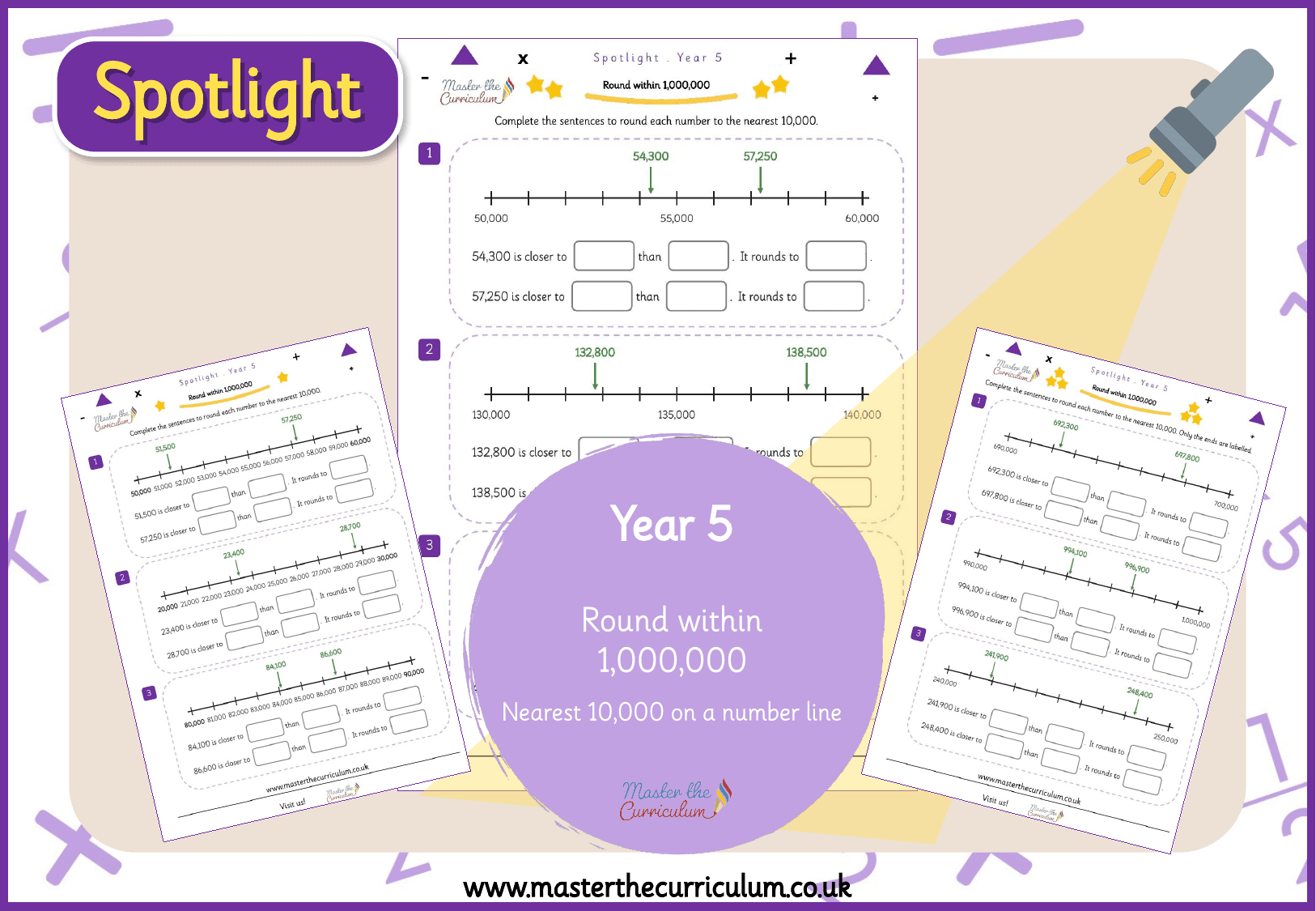
Spotlight Y5 Round to the Nearest 10,000 on a Number Line
masterthecurriculum.co.uk
3 levelsIncluded with membership
Trusted by primary teachers across the UK · New resources every week
Preview only. The download is one file, listed in full below.
Every page is shown before you download. The files themselves come with membership, or sign in if you already have one.
Included with membership
Unlock with membershipAlready a member? Sign in and it downloads from this page.
Keep it for later and group it with the rest of the block. No account needed to start.
Pupils must be able to combine known additive and multiplicative facts with unitising in tenths and hundredths, including: scaling known additive facts within 10, for example, 0.09 – 0.06 = 0.03 scaling known additive facts that bridge 10, for example, 0.8 + 0.6 = 1.4 scaling known multiplication tables facts, for example 0.03 × 4 = 0.12 scaling division facts derived from multiplication tables, for example, 0.12 ÷ 4 = 0.03 scaling calculation of complements to 100, for example 0.62 6 + 0.38 = 1 For calculations such as 0.8 0.6 1.4+ =, pupils can begin by using tens frames and countersas they did for calculation across 10 (2AS–1), calculation across 100 (3NF–3 ) and calculation across 1,000 (4NF–3), but now using 0.1-value counters (or 0.01 value counters for calculations such as 0.08 + 0.06 = 0.14). Language focus: “8 plus 6 is equal to 14, so 8 tenths plus 6 tenths is equal to 14 tenths.” “14 tenths is equal to 1 one and 4 tenths.” Pupils can initially use 0.1- or 0.01-value counters to understand how a known multiplicative fact, such as 3 × 5 = 15, relates to scaled calculations, such as 3 × 0.5 = 1.5 or 3 × 0.05 = 0.15. Pupils should be able reason in terms of unitising in tenths or hundreds, or in terms of scaling a factor by one-tenth or one-hundredth. It is important for pupils to understand all of the calculations in this criterion in terms of working with units of 0.1 or 0.01, or scaling by one-tenth or one-hundredth for multiplicative calculations. You can find out more about fluency and recording for these calculations here in the calculation and fluency section: Number, place value and number facts: 5NPV–2 and 5NF–2.
This pack is print and go. Our catalogue does not list an editable copy of it, so none is offered here rather than promising a file nobody has opened. Page counts are not printed either, because we do not publish them and a guessed number is worse than none.
Number & Place Value
masterthecurriculum.co.uk
3 levels
Number & Place Value
masterthecurriculum.co.uk
3 levels
Number & Place Value
masterthecurriculum.co.uk
3 levels
Number & Place Value
masterthecurriculum.co.uk
3 levels
Number & Place Value
masterthecurriculum.co.uk
3 levels
Number & Place Value
masterthecurriculum.co.uk
3 levels
Number & Place Value
masterthecurriculum.co.uk
3 levels
Number & Place Value
masterthecurriculum.co.uk
3 levels