

Y5
Geometry
Spotlight Y5 Estimate Angles: Estimate Obtuse Angles
masterthecurriculum.co.uk
3 levelsIncluded with membership
Trusted by primary teachers across the UK · New resources every week
Preview only. The download is one file, listed in full below.
Every page is shown before you download. The files themselves come with membership, or sign in if you already have one.
Included with membership
Unlock with membershipAlready a member? Sign in and it downloads from this page.
Keep it for later and group it with the rest of the block. No account needed to start.
In year 3, pupils learnt to identify right angles and to determine whether a given angle is larger or smaller than a right angle (3G–1). Pupils should now compare angles, including the internal angles of polygons, and be able to identify the largest and smallest angles when there is a clear visual difference. Pupils should be able to use the terms acute, obtuse and reflex when describing and comparing angles, and use conventional markings (arcs) to indicate angles. Language focus “An acute angle is smaller than a right angle.” “An obtuse angle is larger than a right angle but less than the angle on a straight line.” “A reflex angle is larger than the angle on a straight line, but less than the angle for a full turn.” Pupils must learn that we can measure the size of angles just as we can measure the length of sides. They should learn that the unit used is called degrees and indicated by the ° symbol. Pupils should know that there are 360° in a full turn, 90° in a quarter turn or right angle, and 180° in a half turn or on a straight line. Pupils must know that the position of the arc indicating an angle does not affect the size of the angle, which is determined by the amount of turn between the two lines. Similarly, they should know that the length of the lines does not affect the size of the angle between them Language focus: “D is the smallest angle. It is an acute angle.” “C is the largest angle. It is a reflex angle” Before pupils learn to use protractors, they should learn to estimate and approximate common angles, and angles that are close to them, including 90˚, 180˚, other multiples of 10˚, and 45˚. They should use sets of ‘standard angle’ measuring tools (for example, cut out from card) for support in approximating, and to check estimates. Once pupils can make reasonable estimates of angle size, they must learn to make accurate measurements, using a protractor, for angles up to 180˚. It is good practice to make an estimate before taking an accurate measureme
This pack is print and go. Our catalogue does not list an editable copy of it, so none is offered here rather than promising a file nobody has opened. Page counts are not printed either, because we do not publish them and a guessed number is worse than none.
Geometry
masterthecurriculum.co.uk
3 levels
Geometry
masterthecurriculum.co.uk
3 levels
Geometry
masterthecurriculum.co.uk
3 levels
Geometry
masterthecurriculum.co.uk
3 levels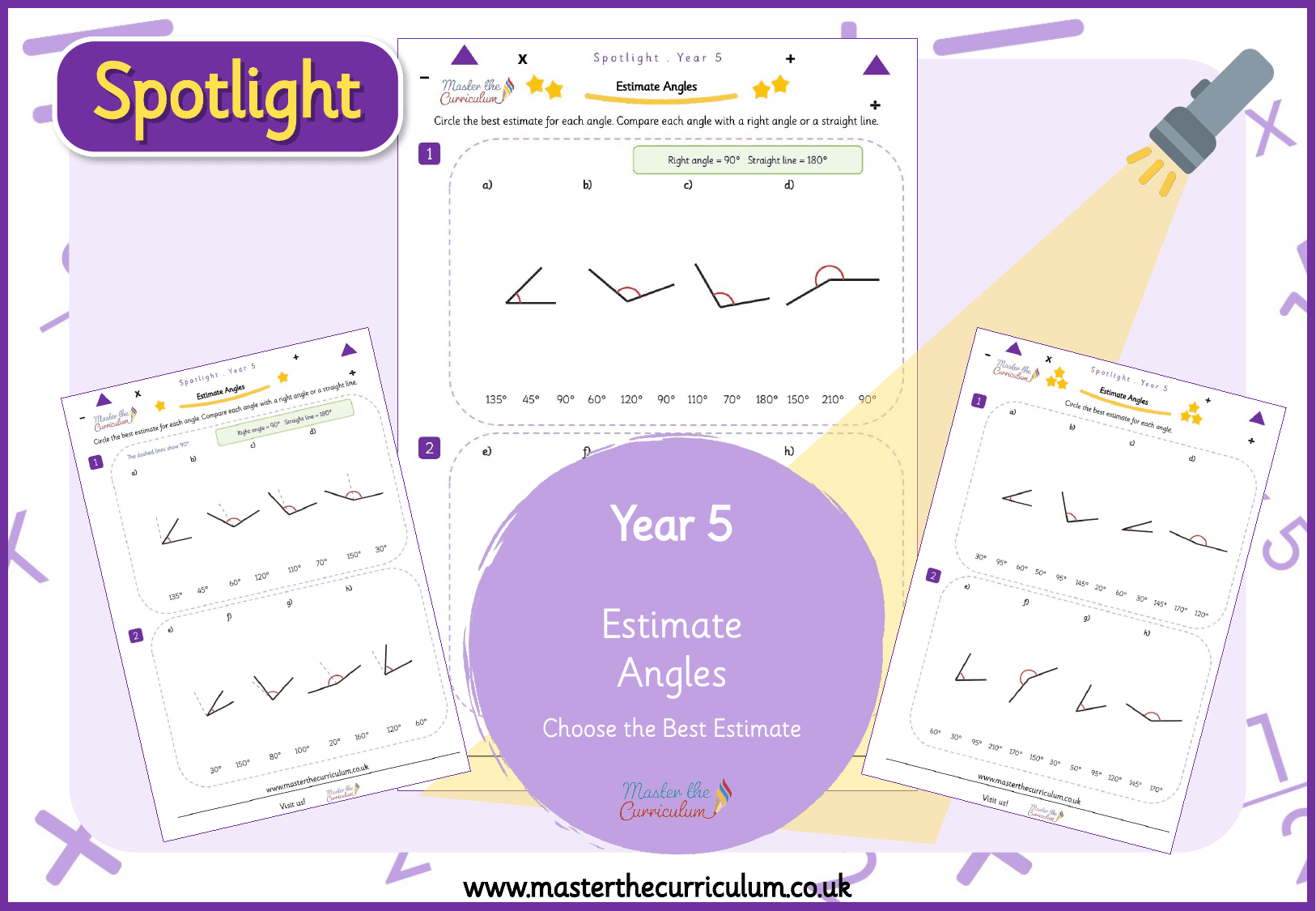
Geometry
masterthecurriculum.co.uk
3 levels
Geometry
masterthecurriculum.co.uk
3 levels
Geometry
masterthecurriculum.co.uk
3 levels
Geometry
masterthecurriculum.co.uk
3 levels