
Y3
Fractions
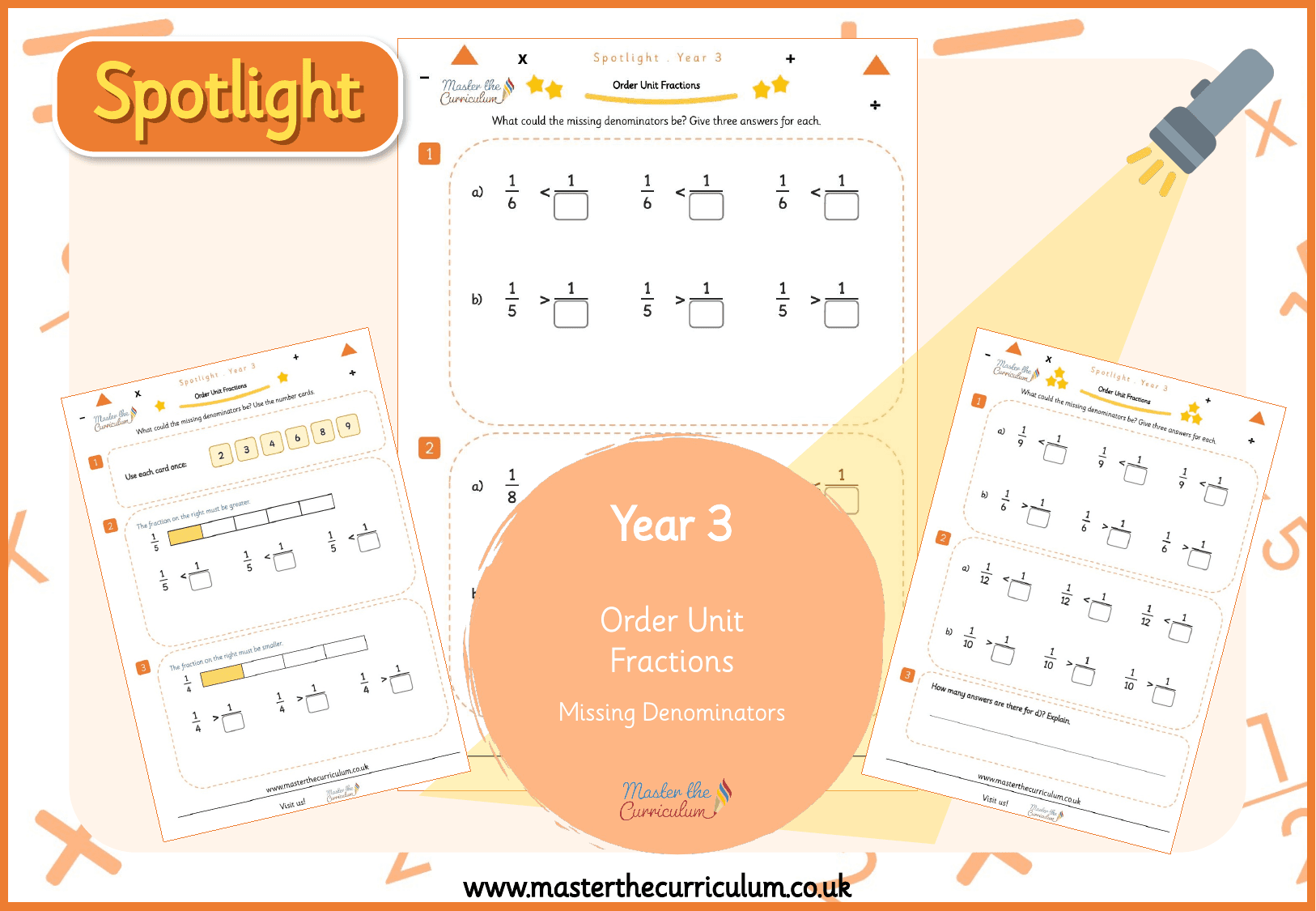
Spotlight Y3 Unit Fractions: Missing Denominators
masterthecurriculum.co.uk
3 levelsIncluded with membership
Trusted by primary teachers across the UK · New resources every week
Preview only. The download is one file, listed in full below.
Every page is shown before you download. The files themselves come with membership, or sign in if you already have one.
Included with membership
Unlock with membershipAlready a member? Sign in and it downloads from this page.
Keep it for later and group it with the rest of the block. No account needed to start.
In 3F–1 pupils learnt how fractions act as operators on a whole. Now they must learn to evaluate the outcome of that operation, for unit fractions of quantities, and connect this to what they already know about dividing quantities into equal parts using known division facts. In year 3, pupils learn the 5, 10, 2, 4 and 8 multiplication tables, so examples in this criterion should be restricted to finding 1/5, 1/10, 1/2, 1/4 or 1/8 of quantities. This allows pupils to focus on the underlying concepts instead of on calculation. Pupils should begin by working with concrete resources or diagrams representing sets. As in 3F–1, they should identify the whole, the number of equal parts, and the size of each part relative to the whole written as a unit fraction. They should then extend their description to quantify the number of items in a part, and connect this to the unit-fraction operator. Language focus “The whole is 12 oranges. The whole is divided into 4 equal parts.” “Each part is 1/4 of the whole. 1/4 of 12 oranges is 3 oranges.” Once pupils can confidently and accurately describe situations where the value of a part is visible, they should learn to calculate the value of a part when it cannot be seen. Bar models are a useful representation here. Pupils should calculate the size of the parts using known division facts, initially with no reference to unit fractions. This is partitive division (3MD–1). Then pupils should make the link between partitive division and finding a fraction of a quantity. They should understand that the situations are the same because both involve dividing a whole into a given number of equal parts. Pupils must understand that, therefore, division facts can be used to find a unit fraction of a quantity. Language focus “To find of 1/5, we divide 15 into 5 equal parts.” “15 divided by 5 is equal to 3, so 1/5 of 15 is equal to 3.”
This pack is print and go. Our catalogue does not list an editable copy of it, so none is offered here rather than promising a file nobody has opened. Page counts are not printed either, because we do not publish them and a guessed number is worse than none.
Fractions
masterthecurriculum.co.uk
3 levels
Fractions
masterthecurriculum.co.uk
3 levels
Fractions
masterthecurriculum.co.uk
3 levels
Fractions
masterthecurriculum.co.uk
3 levels
Fractions
masterthecurriculum.co.uk
3 levels
Fractions
masterthecurriculum.co.uk
3 levels
Fractions
masterthecurriculum.co.uk
3 levels
Fractions
masterthecurriculum.co.uk
3 levels