
Y4
Geometry
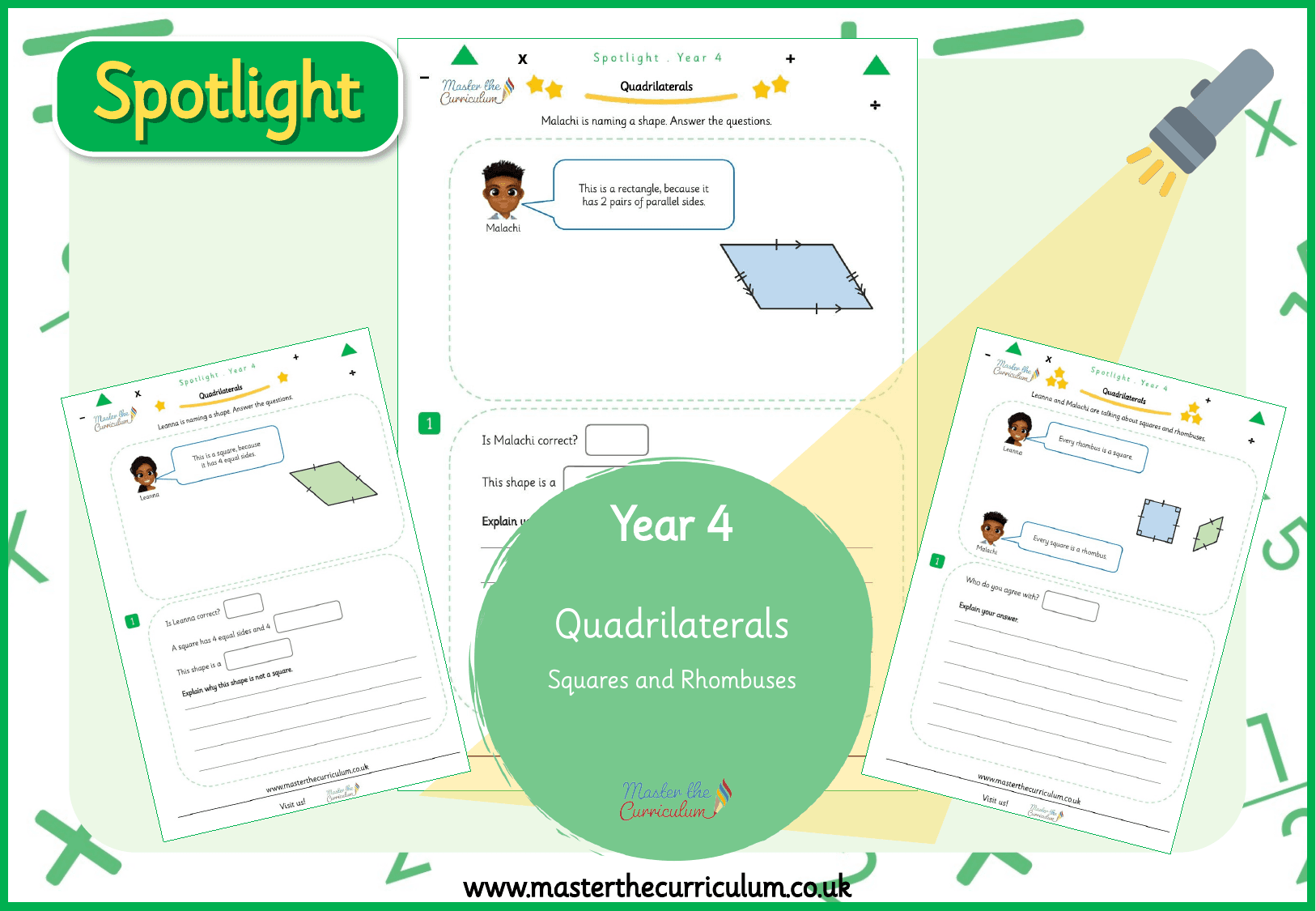
Spotlight Y4 Quadrilaterals: Squares and Rhombuses
masterthecurriculum.co.uk
3 levelsIncluded with membership
Trusted by primary teachers across the UK · New resources every week
Teach Year 4 pupils to find the area of rectilinear shapes by counting squares with this engaging, worksheet-free maths lesson. Featuring interactive teaching slides, practical activities and reasoning challenges, this resource develops a secure understanding of area through hands-on learning.
Preview only. The download is 4 files, listed in full below.
Every page is shown before you download. The files themselves come with membership, or sign in if you already have one.
Included with membership
Unlock with membershipAlready a member? Sign in and it downloads from this page.
Keep it for later and group it with the rest of the block. No account needed to start.
Help your Year 4 class develop a secure understanding of area with this engaging, worksheet-free lesson on finding the area of rectilinear shapes by counting squares. Designed for the Year 4 Spring Measurement unit, this interactive resource introduces pupils to the concept of area as the amount of space inside a shape. Through clear teacher modelling, animated teaching slides and practical activities, children learn how to calculate the area of rectilinear shapes by accurately counting complete squares before applying their understanding to a range of fluency, reasoning and problem-solving tasks. The lesson begins by exploring the difference between area and perimeter, helping pupils understand that area measures the space inside a shape rather than the distance around it. Children then investigate a variety of rectilinear shapes, counting squares systematically to determine the area and discussing efficient strategies for avoiding errors. As their confidence grows, they apply their learning to increasingly complex shapes while explaining and justifying their methods through partner discussions and whole-class reasoning. Designed as a worksheet-free lesson, this resource encourages active participation through practical investigation and mathematical talk, making it ideal for developing conceptual understanding before introducing formal area calculations. This resource includes: Complete Year 4 lesson planning Interactive teaching slides with animations Practical worksheet-free learning activities Area investigations using square grids Fluency, reasoning and problem-solving tasks Whole-class discussion and partner activities Key assessment questions Common misconceptions and teaching guidance Curriculum Coverage: Year 4 Measurement Find the area of rectilinear shapes by counting squares Understand the difference between area and perimeter Count squares accurately and systematically Develop mathematical reasoning and problem-solving Apply area concepts using practic
This pack is listed as editable, so the editable copy comes with it. We do not print page counts here, because our catalogue does not publish them and a guessed number is worse than none.
Geometry, Year 43 numbered lessons
Geometry
masterthecurriculum.co.uk
3 levels
Geometry
masterthecurriculum.co.uk
3 levels
Geometry
masterthecurriculum.co.uk
3 levels
Geometry
masterthecurriculum.co.uk
3 levels
Geometry
masterthecurriculum.co.uk
3 levels
Geometry
masterthecurriculum.co.uk
3 levels
Geometry
masterthecurriculum.co.uk
3 levels
Geometry
masterthecurriculum.co.uk
3 levels