
Y5
Number & Place Value
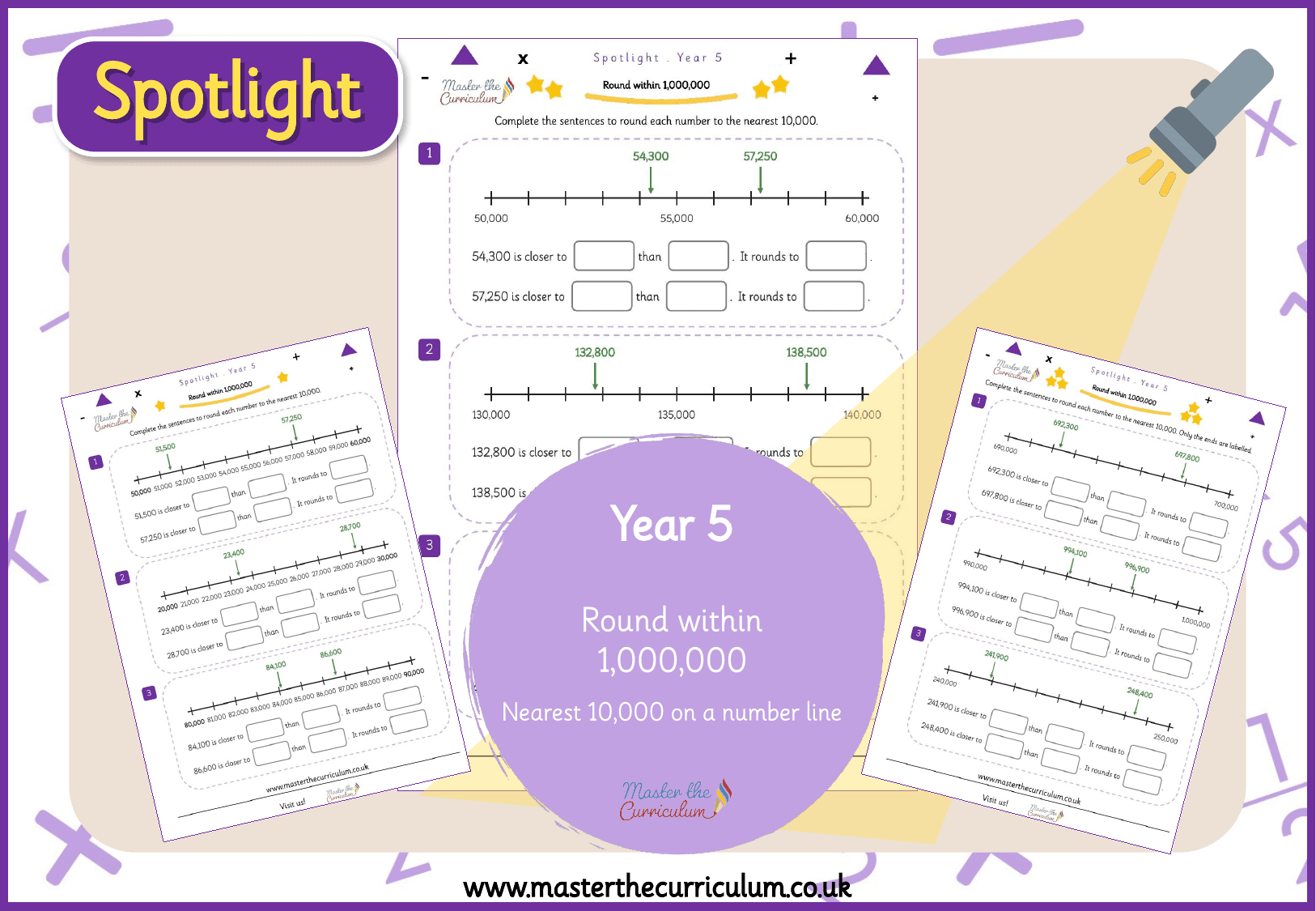
Spotlight Y5 Round to the Nearest 10,000 on a Number Line
masterthecurriculum.co.uk
3 levelsIncluded with membership
Trusted by primary teachers across the UK · New resources every week
Preview only. The download is one file, listed in full below.
Every page is shown before you download. The files themselves come with membership, or sign in if you already have one.
Included with membership
Unlock with membershipAlready a member? Sign in and it downloads from this page.
Keep it for later and group it with the rest of the block. No account needed to start.
Pupils need to become familiar with the relative positons, on a number line, of numbers with 1 and 2 decimal places. They will need to see number lines with both tenths and intermediate hundredths values marked, and learn, for example, that 0.5 is the same as 0.50 and 3 is the same as 3.0 or 3.00. Pupils should recognise the magnitude and position of a given decimal fraction, irrespective of the precision it is given to, for example, 5 tenths lies between 0.45 and 0.55 on the number line below, whether it is represented as 0.5 or 0.50. Pupils need to be able to identify or place decimal fractions on number lines marked in tenths and/or hundredths. They should use efficient strategies and appropriate reasoning, including identifying the midpoints or working backwards from a whole number or a multiple of one tenth. Pupils need to be able to estimate the value or position of decimal fractions on unmarked or partially marked numbers lines, using appropriate proportional reasoning, rather than counting on from a start point or back from an end point. For example, here pupils should reason: “8.6 is about here on the number line because it’s just over half way”. Here, pupils should reason: “8.75 is about here on the number line because it’s the midpoint of 8.7 and 8.8.” Pupils must also be able to identify which whole numbers, or which pair of multiples of 0.1, a given decimal fraction is between. To begin with, pupils can use a number line for support. In this example, for the number 8.61, pupils must identify the previous and next whole number, and the previous and next multiple of 0.1. Language focus: “a is 0.14 because it is 1 hundredth less than the midpoint of 0.1 and 0.2, which is 0.15.” “b is 0.41 because it is 1 hundredth more than 0.4.” By the end of year 5 pupils need to be able to complete this type of task without the support of a number line. Pupils should then learn to round a given decimal fraction to the nearest whole number by identifying the nearest of t
This pack is print and go. Our catalogue does not list an editable copy of it, so none is offered here rather than promising a file nobody has opened. Page counts are not printed either, because we do not publish them and a guessed number is worse than none.
Number & Place Value
masterthecurriculum.co.uk
3 levels
Number & Place Value
masterthecurriculum.co.uk
3 levels
Number & Place Value
masterthecurriculum.co.uk
3 levels
Number & Place Value
masterthecurriculum.co.uk
3 levels
Number & Place Value
masterthecurriculum.co.uk
3 levels
Number & Place Value
masterthecurriculum.co.uk
3 levels
Number & Place Value
masterthecurriculum.co.uk
3 levels
Number & Place Value
masterthecurriculum.co.uk
3 levels