
Y6
Multiplication & Division
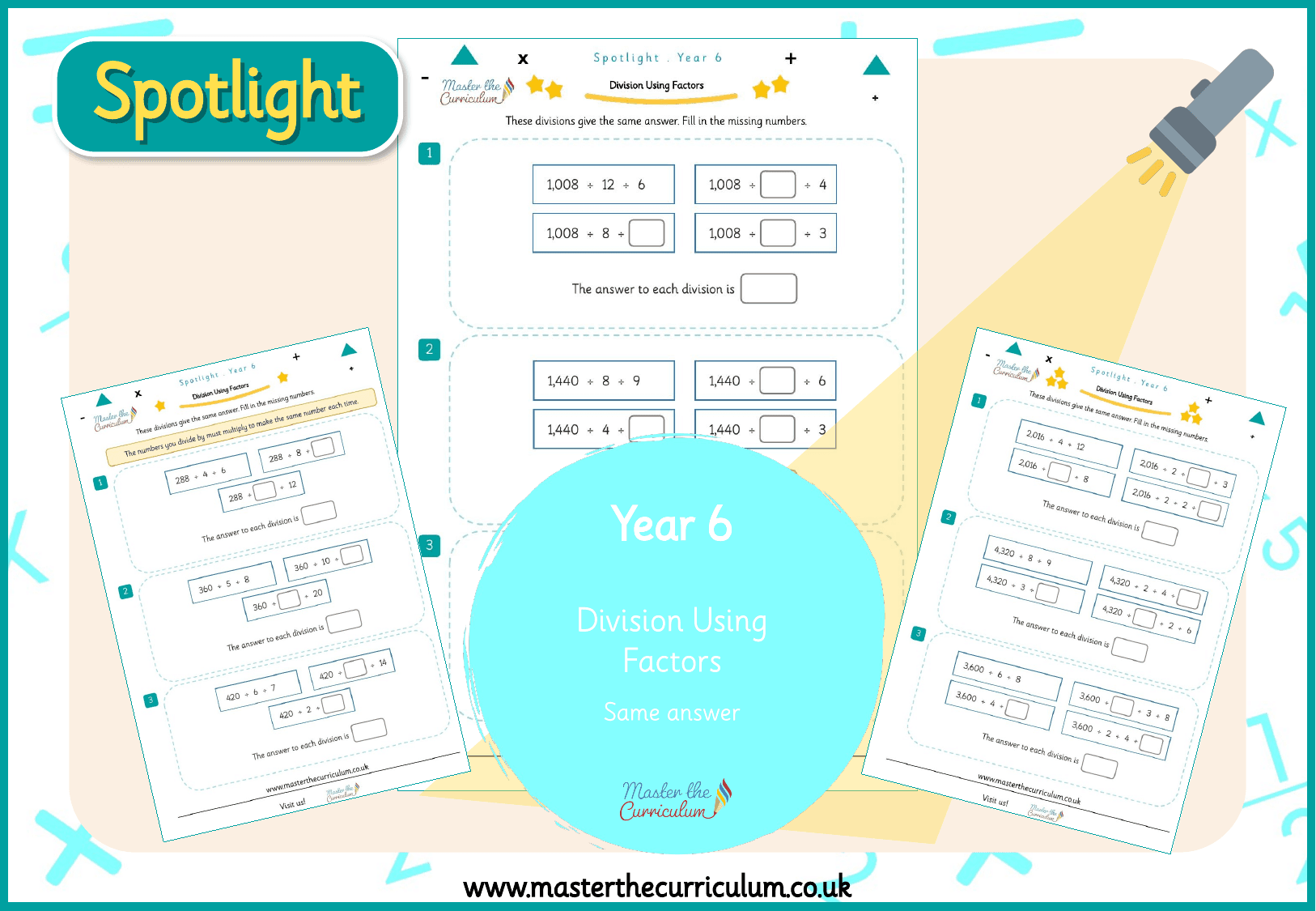
Spotlight Yr6 Division Using Factors: Same Answer
masterthecurriculum.co.uk
3 levelsIncluded with membership
Trusted by primary teachers across the UK · New resources every week
Preview only. The download is one file, listed in full below.
Every page is shown before you download. The files themselves come with membership, or sign in if you already have one.
Included with membership
Unlock with membershipAlready a member? Sign in and it downloads from this page.
Keep it for later and group it with the rest of the block. No account needed to start.
Pupils need to be able to solve problems with 2 unknowns where: there are an infinite number of solutions there is more than 1 solution there is only 1 solution Pupils may have seen equations with 2 unknowns before, for example, when recognising connections between multiplication table facts: 5 × ? = 10 × ? In year 6, pupils must recognise that an equation like this has many (an infinite number) of solutions. They should learn to provide example solutions by choosing a value for one unknown and then calculating the other unknown. Pupils should be able to solve similar problems where there is more than one solution, but not an infinite number, for example: Danny has some 50p coins and some 20p coins. He has £1.70 altogether. How many of each type of coin might he have? In these cases, pupils may choose a value for the first unknown and be unable to solve the equation for the other unknown (pupils may first set the number of 50p pieces at 2, giving £1, only to find that it is impossible to make up the remaining 70p from 20p coins). Pupils should then try a different value until they find a solution. For a bound problem with only a few solutions, like the coin example, pupils should be able to find all possible solutions by working systematically using a table like that shown below. They should be able to reason about the maximum value in each column. Pupils must also learn to solve problems with 2 unknowns that have only 1 solution. Common problems of this type involve 2 pieces of information being given about the relationship between the 2 unknowns – 1 piece of additive information and either another piece of additive information or a piece of multiplicative information. Pupils should learn to draw models to help them solve this type of problem. Pupils should also be able to use bar modelling to solve more complex problems with 2 unknowns and 1 solution, such as: 4 pears and 5 lemons cost £3.35. 4 pears and 2 lemons cost £2.30. What is the cost of 1 lemon? Solving pr
This pack is print and go. Our catalogue does not list an editable copy of it, so none is offered here rather than promising a file nobody has opened. Page counts are not printed either, because we do not publish them and a guessed number is worse than none.
Multiplication & Division
masterthecurriculum.co.uk
3 levels
Addition & Subtraction
masterthecurriculum.co.uk
3 levels
Multiplication & Division
masterthecurriculum.co.uk
3 levels
Multiplication & Division
masterthecurriculum.co.uk
3 levels
Multiplication & Division
masterthecurriculum.co.uk
3 levels
Multiplication & Division
masterthecurriculum.co.uk
3 levels
Multiplication & Division
masterthecurriculum.co.uk
3 levels
Multiplication & Division
masterthecurriculum.co.uk
3 levels