Skip to content

Year 6Addition & Subtraction

Use a given additive or multiplicative calculation to derive or complete a related calculation, using arithmetic properties, inverse relationships, and place-value understanding (1)

CoverCover and first page

Preview only. The download is one file, listed in full below.

Every page is shown before you download. The files themselves come with membership, or sign in if you already have one.

Included with membership

Unlock with membership

Already a member? Sign in and it downloads from this page.

Keep it for later and group it with the rest of the block. No account needed to start.

  • Print it as it is, or as many as you need
  • Instant download, no watermark

About this resource

In previous year groups in key stage 2 pupils have learnt about and used the commutative and associative properties of addition (3AS–3), and the commutative, associative and distributive properties of multiplication (4MD–2 and 4MD–3). Pupils have also implicitly used the compensation property of addition, for example, when partitioning two-digit numbers in different ways in year 2: 70 + 2 = 72 60 + 12 = 72. In year 6, pupils should learn the compensation property of addition. Language focus “If one addend is increased and the other is decreased by the same amount, the sum stays the same.” Pupils should be able to use the compensation property of addition to complete equations such as 25 + 35 = 27.5 +?, and to help them solve calculations such as 25.7 + 32.5. Similarly, pupils may have implicitly used the compensation property of multiplication, for example, when recognising connections between multiplication table facts: 5 × 8 = 10 × 4 In year 6, pupils should learn the compensation property of multiplication. Language focus “If I multiply one factor by a number, I must divide the other factor by the same number for the product to stay the same.” Pupils should be able to use the compensation property of multiplication to complete equations such as 0.3 × 320 = 3 × ?, and to help them solve calculations such as 0.3 × 320. Pupils have extensive experience about the effect on the product of scaling one factor from 3NF–3, 4F–3 and 5NF–2, where they learnt to scale known number facts by 10, 100, one-tenth and one-hundredth. Now they can generalise. Language focus “If I multiply one factor by a number, and keep the other factor the same, I must multiply the product by the same number.” Pupils should practise combining their knowledge of arithmetic properties and relationships to solve problems such as the examples here and in the Example assessment questions below. Pupils should learn to write a series of written equations to justify their solutions. Being able to work fluRead more

In previous year groups in key stage 2 pupils have learnt about and used the commutative and associative properties of addition (3AS–3), and the commutative, associative and distributive properties of multiplication (4MD–2 and 4MD–3). Pupils have also implicitly used the compensation property of addition, for example, when partitioning two-digit numbers in different ways in year 2: 70 + 2 = 72 60 + 12 = 72. In year 6, pupils should learn the compensation property of addition. Language focus “If one addend is increased and the other is decreased by the same amount, the sum stays the same.” Pupils should be able to use the compensation property of addition to complete equations such as 25 + 35 = 27.5 +?, and to help them solve calculations such as 25.7 + 32.5. Similarly, pupils may have implicitly used the compensation property of multiplication, for example, when recognising connections between multiplication table facts: 5 × 8 = 10 × 4 In year 6, pupils should learn the compensation property of multiplication. Language focus “If I multiply one factor by a number, I must divide the other factor by the same number for the product to stay the same.” Pupils should be able to use the compensation property of multiplication to complete equations such as 0.3 × 320 = 3 × ?, and to help them solve calculations such as 0.3 × 320. Pupils have extensive experience about the effect on the product of scaling one factor from 3NF–3, 4F–3 and 5NF–2, where they learnt to scale known number facts by 10, 100, one-tenth and one-hundredth. Now they can generalise. Language focus “If I multiply one factor by a number, and keep the other factor the same, I must multiply the product by the same number.” Pupils should practise combining their knowledge of arithmetic properties and relationships to solve problems such as the examples here and in the Example assessment questions below. Pupils should learn to write a series of written equations to justify their solutions. Being able to work flu

What you get, one file

  • PDFActivity

This pack is print and go. Our catalogue does not list an editable copy of it, so none is offered here rather than promising a file nobody has opened. Page counts are not printed either, because we do not publish them and a guessed number is worse than none.

More addition & subtraction for Year 6

Y6

Multiplication & Division

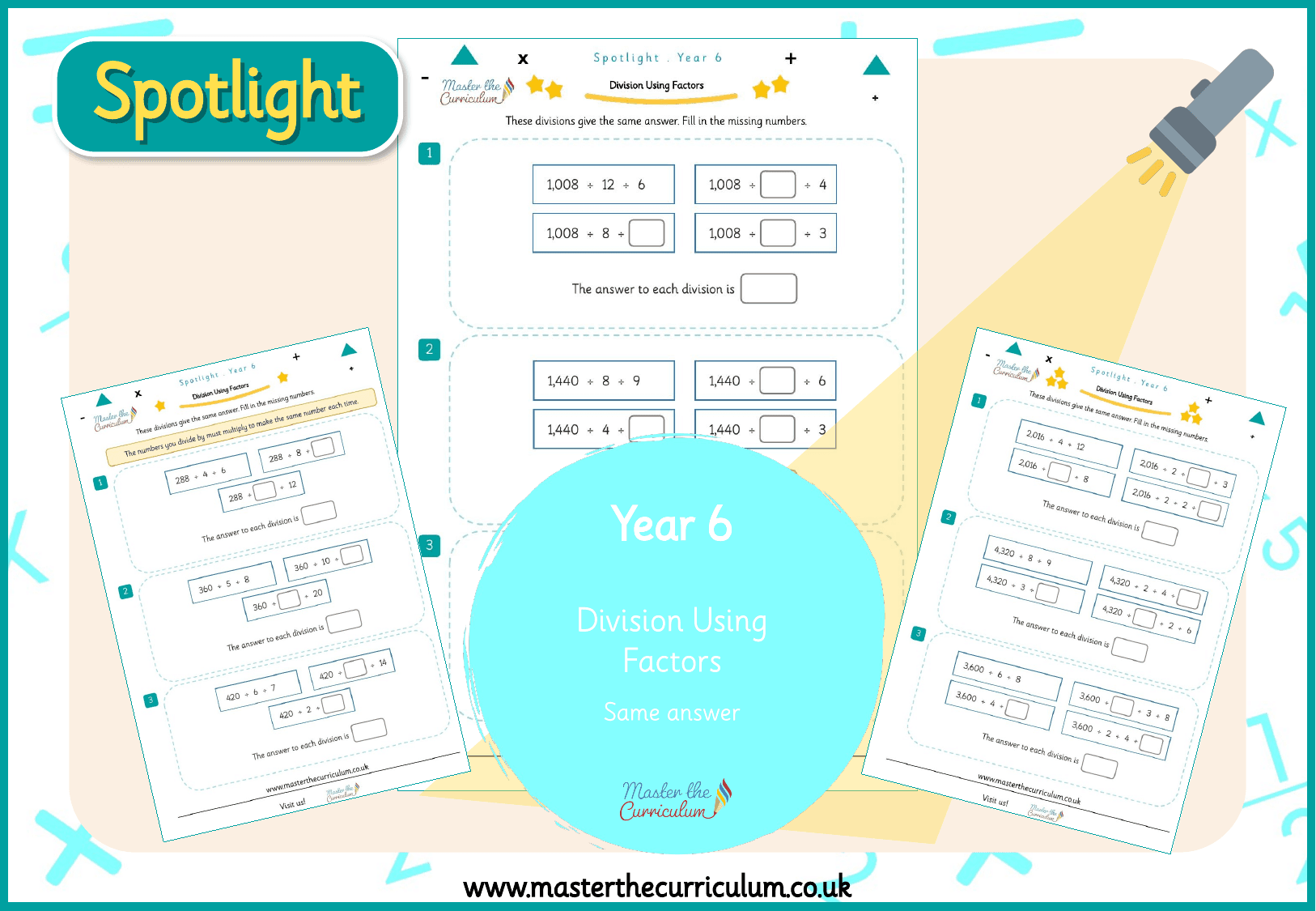
Spotlight Yr6 Division Using Factors: Same Answer

masterthecurriculum.co.uk

3 levels
Included with membership
Y6

Addition & Subtraction

Spotlight Y6 Find the Missing Number in Equivalent Calculations

masterthecurriculum.co.uk

3 levels
Included with membership
Y6

Multiplication & Division

Spotlight Y6 Long Division with Decimals

masterthecurriculum.co.uk

3 levels
Included with membership
Y6

Multiplication & Division

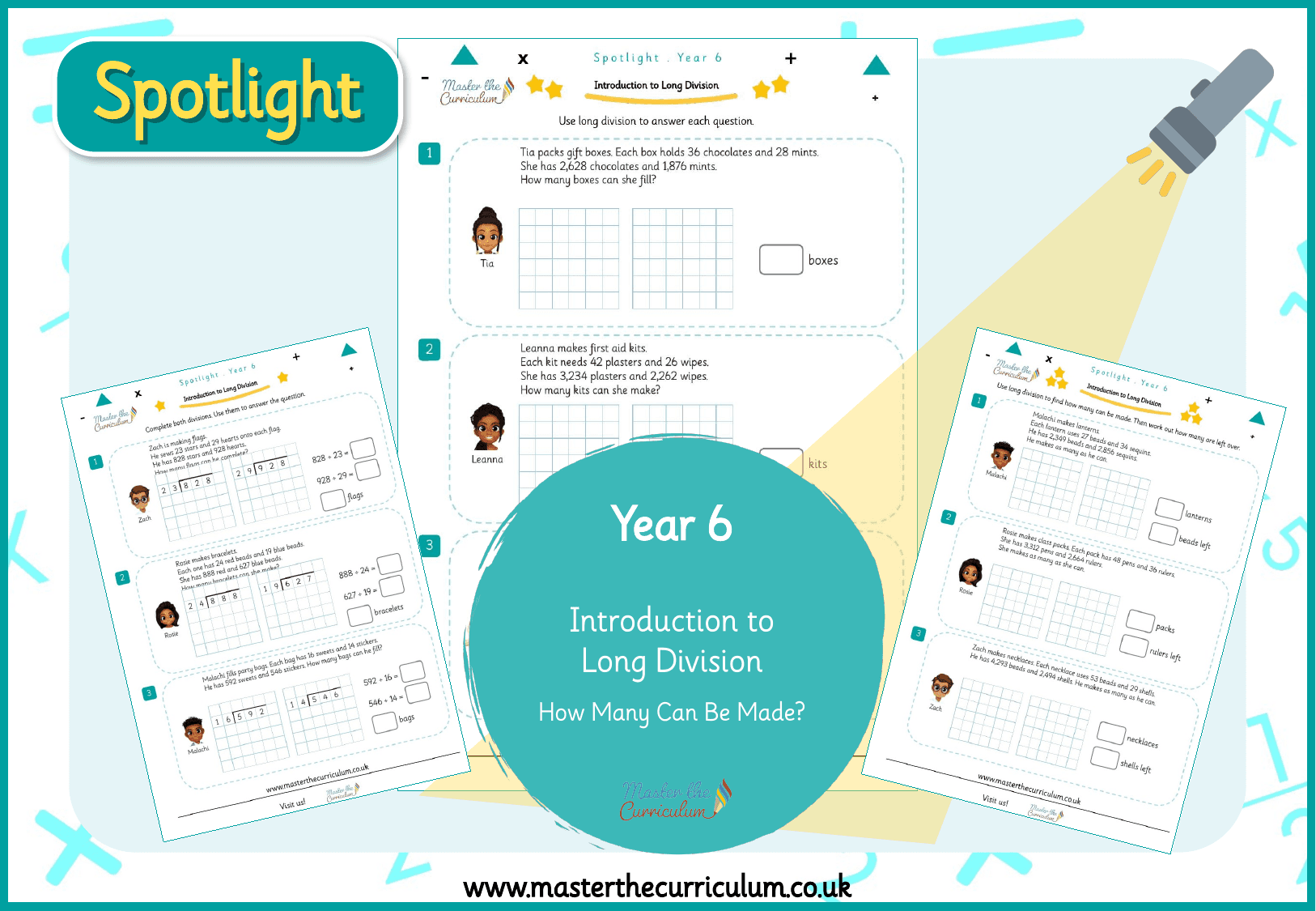
Spotlight Y6 Long Division Word Problems: How Many Can Be Made?

masterthecurriculum.co.uk

3 levels
Included with membership
Y6

Multiplication & Division

Spotlight Y6 Long Division Calculations with the Same Answer

masterthecurriculum.co.uk

3 levels
Included with membership
Y6

Multiplication & Division

Spotlight Y6 Find the Missing Length Using Area and Long Division

masterthecurriculum.co.uk

3 levels
Included with membership
Y6

Multiplication & Division

Spotlight Y6 Write Multiples for Long Division

masterthecurriculum.co.uk

3 levels
Included with membership
Y6

Multiplication & Division

Spotlight Y6 Long Division Using Multiples

masterthecurriculum.co.uk

3 levels
Included with membership

Got a question about this resource?

Leave a message and we’ll get back to you.

Editable resourcesOpens in PowerPoint so you can edit to suit your classWhite Rose supportingFollows the small steps you already plan fromKey eventsSeasonal and cultural resources for the moments in the school yearReasoning Maths HubReasoning and problem solving, by year group

Sign up to keep updated on new resources

An email when there is something new for the year group you actually teach. Unsubscribe in a click.

Year group you teach

We keep your address, and the year group you teach, so we can tell you when there is something new for it. Here is how we look after it: privacy policy.