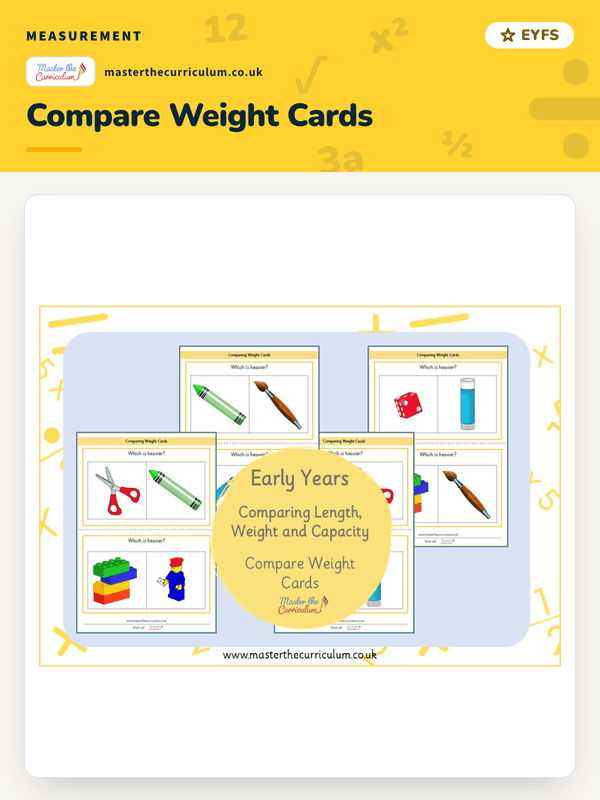
Compare Weight Cards
Included with membership
Trusted by primary teachers across the UK · New resources every week
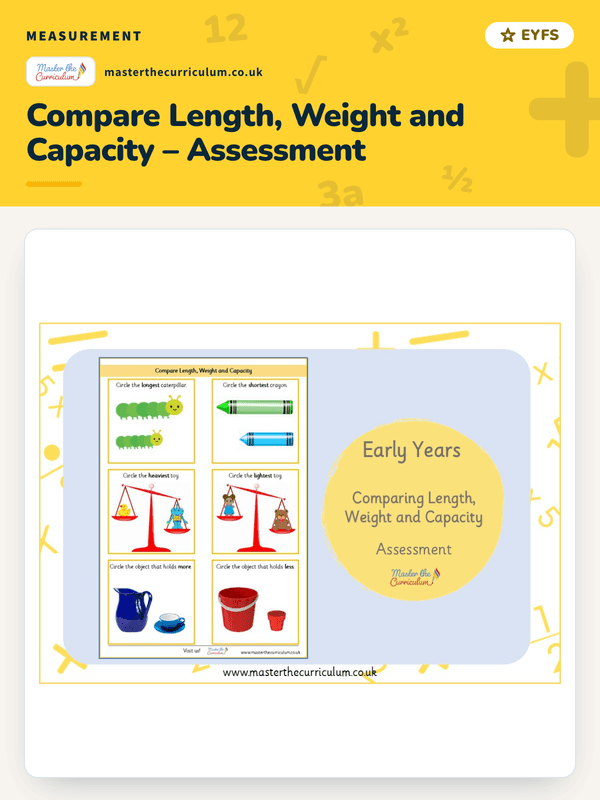
A simple capacity maths activity for EYFS and early years children. Children compare containers to identify which hold the most and least, then identify jars that are full, half full, or empty and colour them to match the labels. Ideal for classroom activities, focus groups, and assessment.
Preview only. The download is one file, listed in full below.
Every page is shown before you download. The files themselves come with membership, or sign in if you already have one.
Included with membership
Unlock with membershipAlready a member? Sign in and it downloads from this page.
Keep it for later and group it with the rest of the block. No account needed to start.
Support children’s early maths learning with this engaging Comparing Capacity Worksheet, designed to help children develop their understanding of capacity and volume. This resource provides a simple and practical way for children to compare different containers and identify which ones hold the most and least. Children are encouraged to look carefully at the containers and compare their capacity before identifying which jar is full, half full, or empty. They can then colour the jars to match the labels, providing an additional opportunity to demonstrate their understanding of capacity vocabulary. This resource is ideal for Early Years Foundation Stage (EYFS) and early primary maths, and can be used as part of a focus group activity, independent task, classroom activity, or assessment opportunity. It is particularly useful for checking children’s understanding of mathematical language such as most, least, full, half full, and empty. Use this capacity activity to support children in developing their early measurement skills while giving practitioners and teachers an opportunity to observe and assess their understanding of comparing capacity.
This pack is print and go. Our catalogue does not list an editable copy of it, so none is offered here rather than promising a file nobody has opened. Page counts are not printed either, because we do not publish them and a guessed number is worse than none.