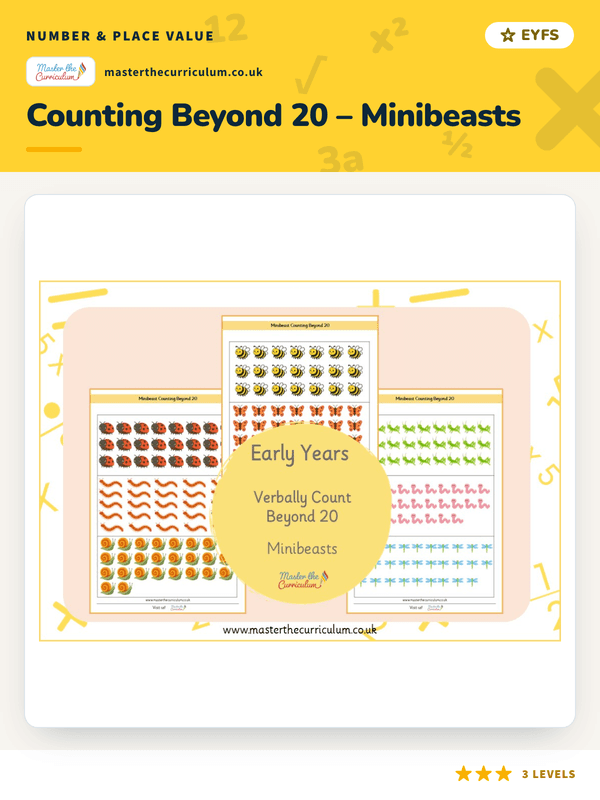
Counting Beyond 20 – Minibeasts
Included with membership
Trusted by primary teachers across the UK · New resources every week
Help children develop their understanding of number composition to 10 with these differentiated maths worksheets. Children draw the extra counters needed to make each number and then complete either a sentence or number sentence to show their understanding. Ideal for developing number bonds to 10 and early addition skills.
Preview only. The download is one file, listed in full below.
Every page is shown before you download. The files themselves come with membership, or sign in if you already have one.
Included with membership
Unlock with membershipAlready a member? Sign in and it downloads from this page.
Keep it for later and group it with the rest of the block. No account needed to start.
Help children develop a deeper understanding of the composition of numbers to 10 with these engaging and differentiated maths worksheets. Children are encouraged to think about how numbers are made and identify the additional counters needed to make the target number. For each activity, children look at the number shown and draw the extra counters needed to make the number. This encourages them to think about the relationship between quantities and develop an understanding of the different ways numbers can be composed. There are two versions of the resource, providing different levels of support and challenge. In one version, children complete a sentence to describe the composition of the number. In the second version, children complete a number sentence, helping them begin to represent their understanding using mathematical notation. This resource provides valuable practice for developing an understanding of number bonds to 10 and the part-part-whole relationship. It encourages children to move beyond simply counting objects and begin to recognise how quantities can be combined to make a whole number. Children can practise: Understanding the composition of numbers to 10 Exploring number bonds to 10 Recognising parts and wholes Counting accurately Identifying how many more are needed Representing quantities using counters Completing mathematical sentences Completing number sentences Developing early addition skills Explaining how numbers are made The differentiated versions make this resource suitable for Early Years and KS1 maths and allow children to work at an appropriate level of challenge. It can be used for independent learning, small-group activities, maths interventions or as a follow-up to practical number bond activities. The worksheet works particularly well alongside practical manipulatives such as counters, allowing children to physically explore different combinations before recording their thinking on paper. A useful number bonds to 10 maths resource
This pack is print and go. Our catalogue does not list an editable copy of it, so none is offered here rather than promising a file nobody has opened. Page counts are not printed either, because we do not publish them and a guessed number is worse than none.
Our own system, with the star count repeated in every worksheet header so a child can be handed the right sheet without a word.