
Y2
Geometry
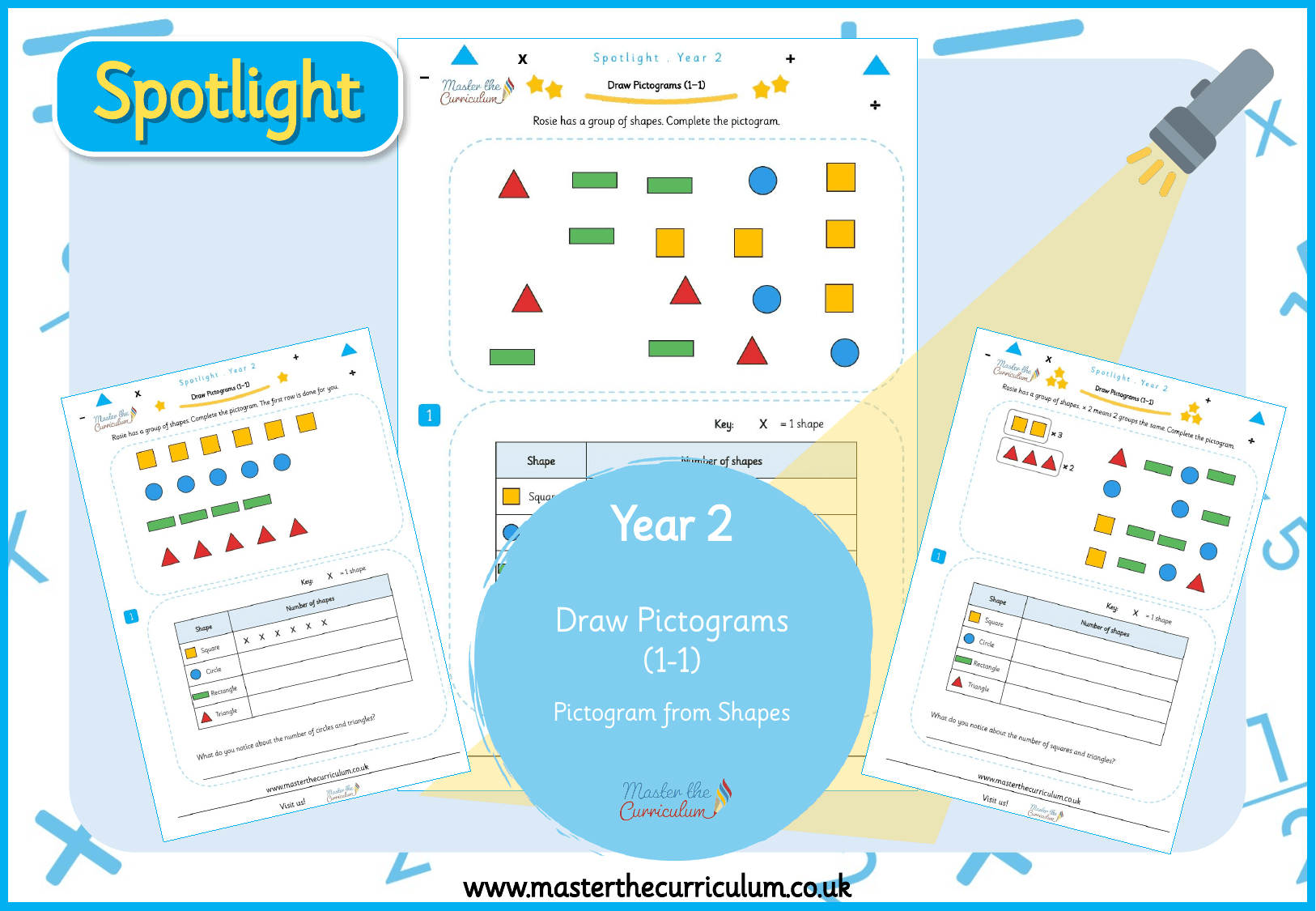
Spotlight Y2 Draw Pictograms: Pictogram from Shapes
masterthecurriculum.co.uk
3 levelsIncluded with membership
Trusted by primary teachers across the UK · New resources every week
A Working Without Worksheets Year 2 lesson on 3-D shape properties. Pupils explore, name, and describe faces, edges, and vertices through practical activities—no worksheets needed.
Preview only. The download is 4 files, listed in full below.
Every page is shown before you download. The files themselves come with membership, or sign in if you already have one.
Included with membership
Unlock with membershipAlready a member? Sign in and it downloads from this page.
Keep it for later and group it with the rest of the block. No account needed to start.
Working Without Worksheets – Year 2 Lesson: Properties of 3-D Shapes Deepen children’s understanding of 3-D shapes with this practical Working Without Worksheets lesson for Year 2 Geometry. Designed for classrooms that prioritise active, hands-on learning over worksheets, this pack helps pupils explore and describe the properties of 3-D shapes using real objects and clear mathematical language. The lesson begins with a recap of common 3-D shapes learned in Year 1, such as cubes, cuboids, spheres, cones, and pyramids. Pupils handle real 3-D shapes to explore their physical properties, learning the difference between faces, edges, and vertices, and discussing how curved surfaces differ from flat faces. In the main activity, children glue pictures of 3-D shapes into their maths books, naming each shape and writing sentences about its properties — for example: This is a cube. It has 6 faces, 12 edges, and 8 vertices. Children are encouraged to notice exceptions, such as shapes with curved surfaces or an apex, developing deeper reasoning and accurate mathematical vocabulary. The plenary challenges pupils to solve a reasoning problem (“I am thinking of a shape…”) to decide which 3-D shape could fit a description, reinforcing how careful, detailed explanations help identify shapes correctly. What’s Included in the Pack? ✔ Full teacher planning with objectives, activities, and plenary guidance ✔ Starter: recap and name common 3-D shapes from Year 1 ✔ Vocabulary focus: face, edge, vertex, curved surface, apex ✔ Practical task: handle 3-D shapes and count faces, edges, and vertices ✔ Independent activity: glue 3-D shape pictures and describe their properties ✔ Plenary: reasoning challenge – “I am thinking of a shape…” ✔ No worksheets—children record directly in their books Why Teachers Love This Resource: ✔ Makes 3-D shape learning tactile and engaging through real-life exploration ✔ Builds understanding of faces, edges, and vertices using concrete resources ✔ Fully aligned w
This pack is listed as editable, so the editable copy comes with it. We do not print page counts here, because our catalogue does not publish them and a guessed number is worse than none.
Geometry, Year 24 numbered lessons
Geometry
masterthecurriculum.co.uk
3 levels
Geometry
masterthecurriculum.co.uk
3 levels
Geometry
masterthecurriculum.co.uk
3 levels
Geometry
masterthecurriculum.co.uk
3 levels
Geometry
masterthecurriculum.co.uk
3 levels
Geometry
masterthecurriculum.co.uk
3 levels
Geometry
masterthecurriculum.co.uk
3 levels
Geometry
masterthecurriculum.co.uk
3 levels