
Y2
Geometry
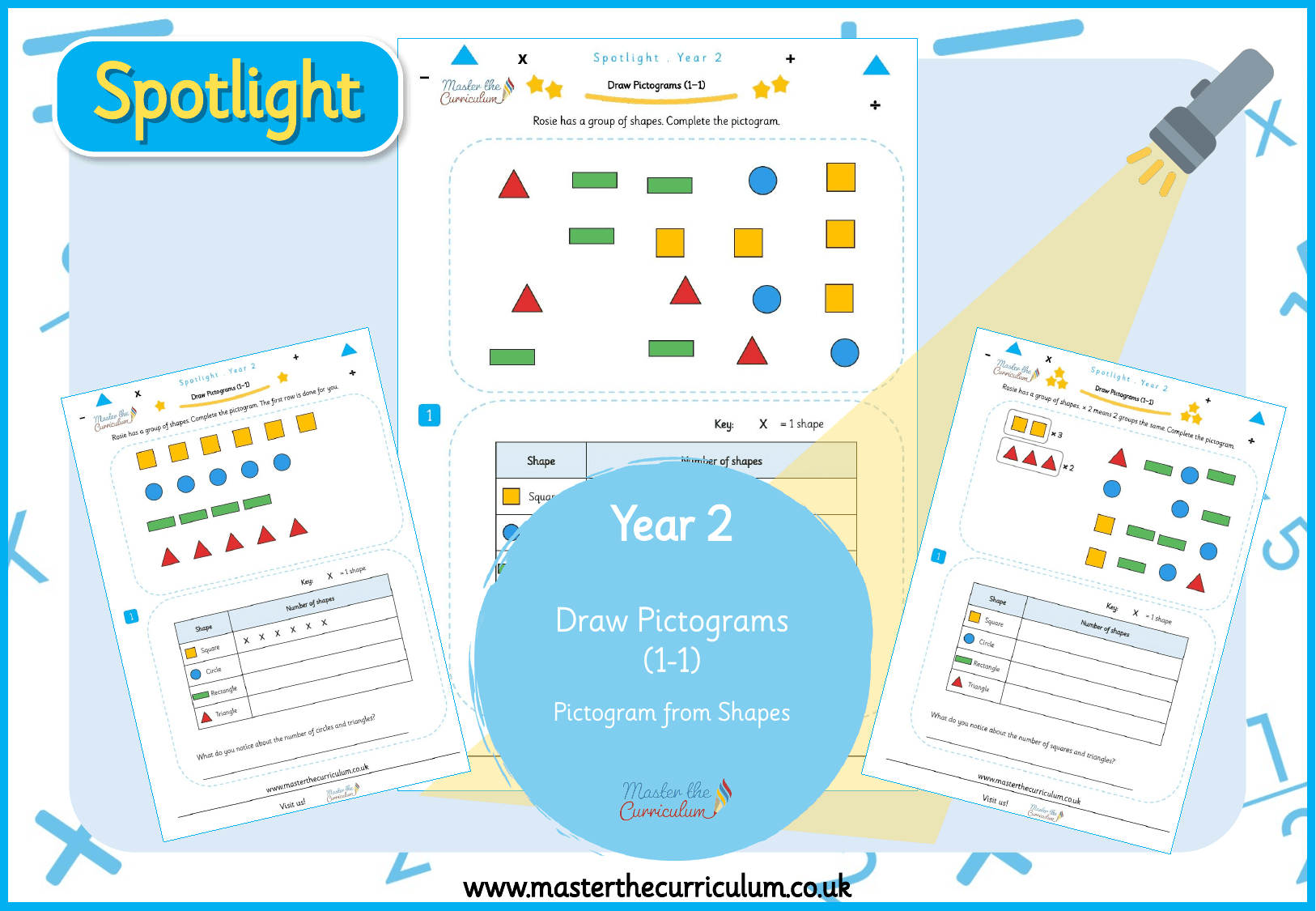
Spotlight Y2 Draw Pictograms: Pictogram from Shapes
masterthecurriculum.co.uk
3 levelsIncluded with membership
Trusted by primary teachers across the UK · New resources every week
A practical and engaging Year 2 geometry lesson where children compare, sort, and identify 2-D and 3-D shapes through real-world exploration. Featuring a shape quiz, feely bag activity, and a hands-on shape hunt around school — perfect for active learning without worksheets!
Preview only. The download is 4 files, listed in full below.
Every page is shown before you download. The files themselves come with membership, or sign in if you already have one.
Included with membership
Unlock with membershipAlready a member? Sign in and it downloads from this page.
Keep it for later and group it with the rest of the block. No account needed to start.
This Year 2 Working Without Worksheets lesson brings geometry to life as children compare and sort 2-D and 3-D shapes and objects through hands-on exploration, discussion, and reasoning. Designed to consolidate understanding at the end of a shape unit, this lesson blends fun, curiosity, and practical learning in line with the Year 2 National Curriculum. The lesson begins with a lively feely bag game, where pupils describe and identify hidden shapes using key vocabulary — sides, corners, edges, faces, and vertices — allowing the teacher to assess understanding and address misconceptions in real time. Children then move into a quick-fire shape quiz and sorting task, using hoops to group shapes based on self-chosen criteria (such as number of faces, curved surfaces, or vertices). During the main activity, children head out on a 3-D shape hunt around the classroom or school. They identify everyday objects and match them to 3-D shapes, discussing their properties and noting any visible 2-D faces. This real-world connection strengthens spatial awareness and helps children see how geometry applies to everyday life — from balls that roll to boxes that stack. The plenary deepens reasoning by prompting children to think critically about why certain objects are the shapes they are. For example, “Why are wheels circular?” or “Why is a brick cuboid-shaped?” Pupils are encouraged to imagine what might happen if everyday objects were made in different shapes, fostering curiosity and deeper understanding. What’s Included in the Pack ✔ Full lesson plan with learning objectives, teaching notes, and plenary guidance ✔ Animated teaching slides and quiz for whole-class discussion ✔ Starter: Feely bag game to describe and identify 2-D and 3-D shapes ✔ Main activity: 3-D shape hunt around the classroom or school grounds ✔ Plenary: Discussion on why certain shapes are used in real-life objects ✔ Encourages exploration, reasoning, and creative thinking ✔ 100% worksheet-free and perfect for
This pack is listed as editable, so the editable copy comes with it. We do not print page counts here, because our catalogue does not publish them and a guessed number is worse than none.
Geometry, Year 24 numbered lessons
Geometry
masterthecurriculum.co.uk
3 levels
Geometry
masterthecurriculum.co.uk
3 levels
Geometry
masterthecurriculum.co.uk
3 levels
Geometry
masterthecurriculum.co.uk
3 levels
Geometry
masterthecurriculum.co.uk
3 levels
Geometry
masterthecurriculum.co.uk
3 levels
Geometry
masterthecurriculum.co.uk
3 levels
Geometry
masterthecurriculum.co.uk
3 levels