Skip to content

Year 6Number & Place Value

Reason about the location of any number up to 10 million, including decimal fractions, in the linear number system, and round numbers, as appropriate, including in contexts (2)

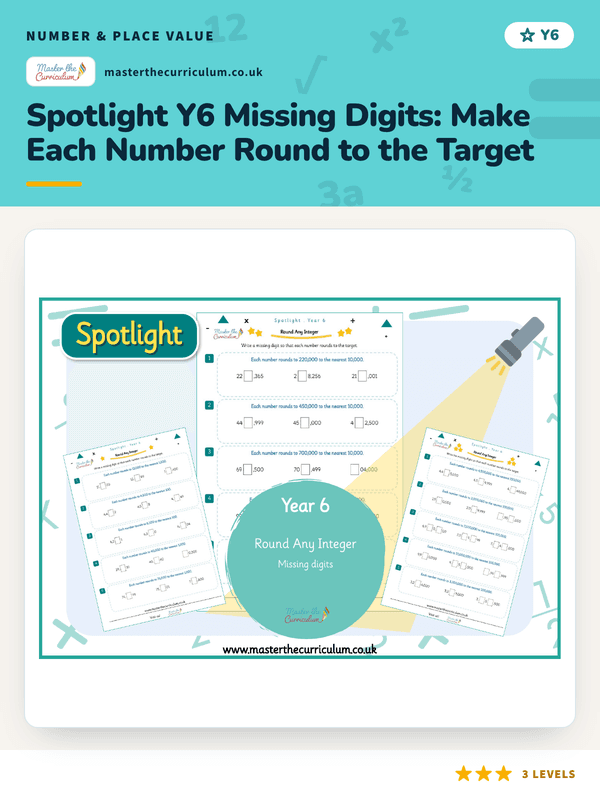
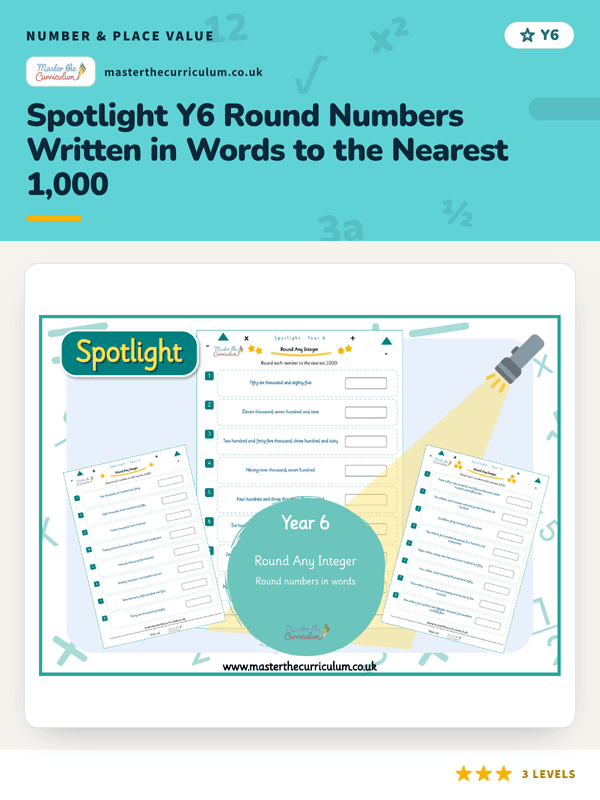
CoverCover and first page

Preview only. The download is one file, listed in full below.

Every page is shown before you download. The files themselves come with membership, or sign in if you already have one.

Included with membership

Unlock with membership

Already a member? Sign in and it downloads from this page.

Keep it for later and group it with the rest of the block. No account needed to start.

  • Print it as it is, or as many as you need
  • Instant download, no watermark

About this resource

Pupils have already learnt about the location of whole numbers with up to 4 digits in the linear number system (1NPV–2, 2NPV–2, 3NPV–3 and 4NPV–3) and about the location of decimal fractions with up to 2 decimal places between whole numbers in the linear number system (5NPV–3). Pupils must now extend their understanding to larger numbers. Pupils need to be able to identify or place numbers with up to 7 digits on marked number lines with a variety of scales, for example placing 12,500 on a 12,000 to 13,000 number line, and on a 10,000 to 20,000 number line. Pupils need to be able to estimate the value or position of numbers on unmarked or partially marked numbers lines, using appropriate proportional reasoning. In the example below, pupils should reason: “a must be about 875,000 because it is about halfway between the midpoint of the number line, which is 850,000, and 900,000.” Pupils should understand that, to estimate the position of a number with more significant digits on a large-value number line, they must attend to the leading digits and can ignore values in the smaller place-value positions. For example, when estimating the position of 5,192,012 on a 5,100,000 to 5,200,000 number line they only need to attend to the first 4 digits. Pupils must also be able to round numbers in preparation for key stage 3, when they will learn to round numbers to a given number of significant figures or decimal places. They have already learnt to round numbers with up to 4 digits to the nearest multiple of 1,000, 100 and 10, and to round decimal fractions to the nearest whole number or multiple of 0.1. Now pupils should extend this to larger numbers. They must also learn that numbers are rounded for the purpose of eliminating an unnecessary level of detail. They must understand that rounding is a method of approximating, and that rounded numbers can be used to give estimated values including estimated answers to calculations. Pupils should only be asked to round numbers to a usRead more

Pupils have already learnt about the location of whole numbers with up to 4 digits in the linear number system (1NPV–2, 2NPV–2, 3NPV–3 and 4NPV–3) and about the location of decimal fractions with up to 2 decimal places between whole numbers in the linear number system (5NPV–3). Pupils must now extend their understanding to larger numbers. Pupils need to be able to identify or place numbers with up to 7 digits on marked number lines with a variety of scales, for example placing 12,500 on a 12,000 to 13,000 number line, and on a 10,000 to 20,000 number line. Pupils need to be able to estimate the value or position of numbers on unmarked or partially marked numbers lines, using appropriate proportional reasoning. In the example below, pupils should reason: “a must be about 875,000 because it is about halfway between the midpoint of the number line, which is 850,000, and 900,000.” Pupils should understand that, to estimate the position of a number with more significant digits on a large-value number line, they must attend to the leading digits and can ignore values in the smaller place-value positions. For example, when estimating the position of 5,192,012 on a 5,100,000 to 5,200,000 number line they only need to attend to the first 4 digits. Pupils must also be able to round numbers in preparation for key stage 3, when they will learn to round numbers to a given number of significant figures or decimal places. They have already learnt to round numbers with up to 4 digits to the nearest multiple of 1,000, 100 and 10, and to round decimal fractions to the nearest whole number or multiple of 0.1. Now pupils should extend this to larger numbers. They must also learn that numbers are rounded for the purpose of eliminating an unnecessary level of detail. They must understand that rounding is a method of approximating, and that rounded numbers can be used to give estimated values including estimated answers to calculations. Pupils should only be asked to round numbers to a us

What you get, one file

  • PDFActivity

This pack is print and go. Our catalogue does not list an editable copy of it, so none is offered here rather than promising a file nobody has opened. Page counts are not printed either, because we do not publish them and a guessed number is worse than none.

More number & place value for Year 6

Y5

Number & Place Value

Spotlight Y5 Make 5-Digit Numbers in a Range and Order Them

masterthecurriculum.co.uk

3 levels
Included with membership

Got a question about this resource?

Leave a message and we’ll get back to you.

Editable resourcesOpens in PowerPoint so you can edit to suit your classWhite Rose supportingFollows the small steps you already plan fromKey eventsSeasonal and cultural resources for the moments in the school yearReasoning Maths HubReasoning and problem solving, by year group

Sign up to keep updated on new resources

An email when there is something new for the year group you actually teach. Unsubscribe in a click.

Year group you teach

We keep your address, and the year group you teach, so we can tell you when there is something new for it. Here is how we look after it: privacy policy.