Skip to content

Year 1NCETM Ready to Progress

Count forwards and backwards in multiples of 2, 5 and 10 (3)

CoverCover and first page

Preview only. The download is one file, listed in full below.

Every page is shown before you download. The files themselves come with membership, or sign in if you already have one.

Included with membership

Unlock with membership

Already a member? Sign in and it downloads from this page.

Keep it for later and group it with the rest of the block. No account needed to start.

  • Print it as it is, or as many as you need
  • Instant download, no watermark

About this resource

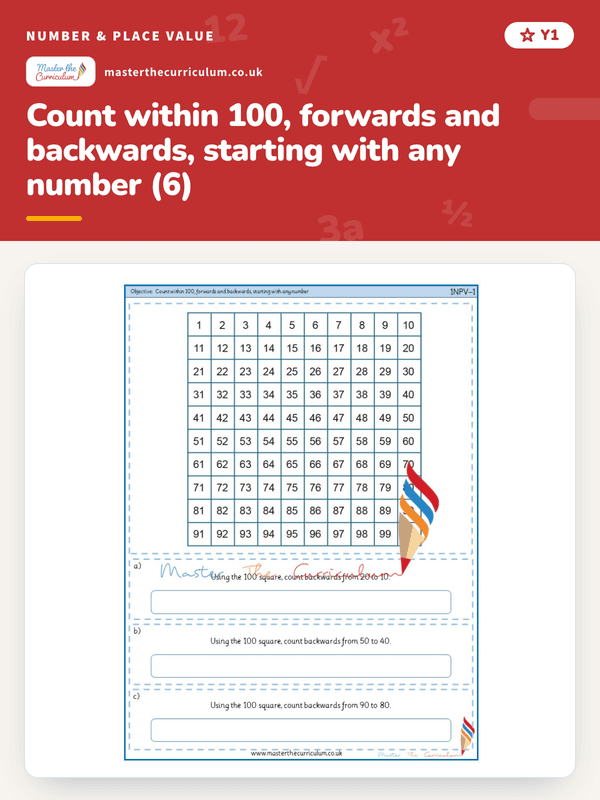
Pupils must be able to count in multiples of 2, 5 and 10 by the end of year 1 so that they are ready to progress to multiplication involving groups of 2, 5 and 10 in year 2. As with counting in ones, within 100 (1NPV–1 ), this is a skill that will need to be practised throughout year 1. As with 1NPV–1, forwards and backwards counting practice should include: reciting just the number names (for example, “ten, twenty, thirty…”), without the support of visual representations counting with the support of visual representations and gestural patterns, for example pupils can point to numerals on a number line or 100 square, or tap out the numbers on a Gattegno chart starting the forwards counting sequence with numbers other than 2, 5 or 10 The 100 square and Gattegno chart are provided in criterion 1NPV–1 in figures 1 and 3 respectively. When pupils are confident with the counting sequences, they should learn to enumerate objects arranged in groups of 2, 5 or 10 by skip counting, so they begin to connect counting in multiples with finding the total quantity for repeated groups. Pupils should first identify how many objects are in each repeated group, and then skip count in this number. They should leave year 1 understanding that when objects are grouped equally, it is more efficient to skip count than to count in ones. Recognising that a group of 5, for example, can be treated as a single unit is called unitising, and is the basis of multiplicative reasoning.Read more

Pupils must be able to count in multiples of 2, 5 and 10 by the end of year 1 so that they are ready to progress to multiplication involving groups of 2, 5 and 10 in year 2. As with counting in ones, within 100 (1NPV–1 ), this is a skill that will need to be practised throughout year 1. As with 1NPV–1, forwards and backwards counting practice should include: reciting just the number names (for example, “ten, twenty, thirty…”), without the support of visual representations counting with the support of visual representations and gestural patterns, for example pupils can point to numerals on a number line or 100 square, or tap out the numbers on a Gattegno chart starting the forwards counting sequence with numbers other than 2, 5 or 10 The 100 square and Gattegno chart are provided in criterion 1NPV–1 in figures 1 and 3 respectively. When pupils are confident with the counting sequences, they should learn to enumerate objects arranged in groups of 2, 5 or 10 by skip counting, so they begin to connect counting in multiples with finding the total quantity for repeated groups. Pupils should first identify how many objects are in each repeated group, and then skip count in this number. They should leave year 1 understanding that when objects are grouped equally, it is more efficient to skip count than to count in ones. Recognising that a group of 5, for example, can be treated as a single unit is called unitising, and is the basis of multiplicative reasoning.

What you get, one file

  • PDFActivity

This pack is print and go. Our catalogue does not list an editable copy of it, so none is offered here rather than promising a file nobody has opened. Page counts are not printed either, because we do not publish them and a guessed number is worse than none.

More ncetm ready to progress for Year 1

Got a question about this resource?

Leave a message and we’ll get back to you.

Editable resourcesOpens in PowerPoint so you can edit to suit your classWhite Rose supportingFollows the small steps you already plan fromKey eventsSeasonal and cultural resources for the moments in the school yearReasoning Maths HubReasoning and problem solving, by year group

Sign up to keep updated on new resources

An email when there is something new for the year group you actually teach. Unsubscribe in a click.

Year group you teach

We keep your address, and the year group you teach, so we can tell you when there is something new for it. Here is how we look after it: privacy policy.