Skip to content

Year 2Working Without Worksheets

L3 Tables

A Working Without Worksheets Year 2 lesson on constructing and interpreting tables. Pupils collect data, tally results, and record totals through practical class tasks—no worksheets needed.

CoverCover and first page

Preview only. The download is 4 files, listed in full below.

Every page is shown before you download. The files themselves come with membership, or sign in if you already have one.

Included with membership

Unlock with membership

Already a member? Sign in and it downloads from this page.

Keep it for later and group it with the rest of the block. No account needed to start.

  • Print it as it is, or as many as you need
  • Instant download, no watermark

About this resource

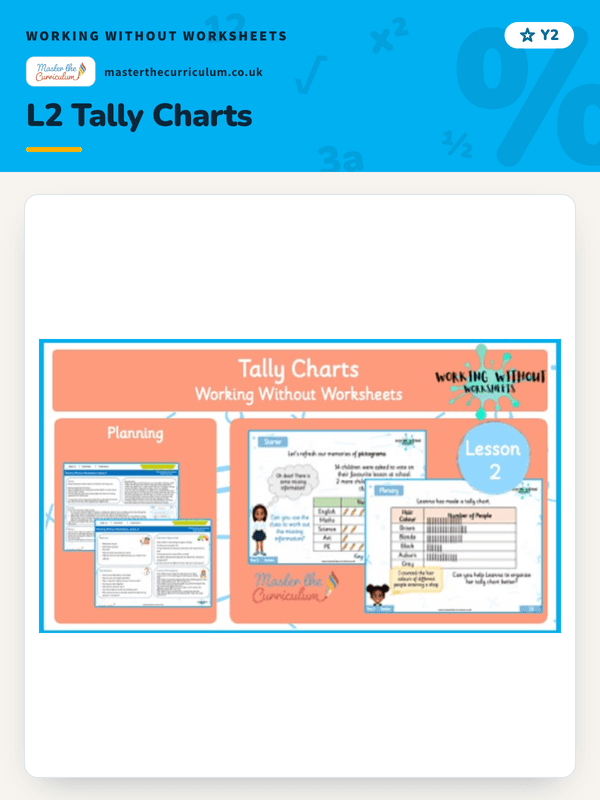
Help pupils develop data handling skills with this engaging Working Without Worksheets lesson for Year 2 Statistics. Designed for classrooms that focus on practical, hands-on learning, this lesson teaches children how to interpret and construct simple tables through interactive class investigations—without a single worksheet. The lesson begins with a lively recap of tally charts. In pairs, children time each other to see how many jumps and spins they can complete in 30 seconds, tallying their results on whiteboards. The teacher models how this information can be transferred from a tally chart into a table, introducing the idea of adding a totals column and an overall total at the bottom. Pupils discover that tables help us organise data clearly and see patterns more easily than tallies alone. In the main activity, the class works together to create a table showing their favourite meals. Children first tally class votes before independently completing the totals column and adding the overall total. The teacher supports those who need extra help with addition or recording. Later, pupils explore another example table showing the number of countries visited by a class, learning how to interpret data and answer questions. They discuss how some children might have chosen more than one response, reinforcing that totals don’t always equal the number of people surveyed. The plenary encourages children to reflect on what tables show and how they differ from tally charts or pictograms, promoting reasoning and careful interpretation. What’s Included in the Pack? ✔ Full teacher planning with objectives, activities, and plenary guidance ✔ Starter: recap making tally charts with an active jumping and spinning task ✔ Vocabulary focus: table, tally, total, row, column, category, data ✔ Teacher modelling: create a table from class tally results ✔ Practical class task: vote for favourite meals and complete a class table ✔ Independent activity: calculate and record totals in mathRead more

Help pupils develop data handling skills with this engaging Working Without Worksheets lesson for Year 2 Statistics. Designed for classrooms that focus on practical, hands-on learning, this lesson teaches children how to interpret and construct simple tables through interactive class investigations—without a single worksheet. The lesson begins with a lively recap of tally charts. In pairs, children time each other to see how many jumps and spins they can complete in 30 seconds, tallying their results on whiteboards. The teacher models how this information can be transferred from a tally chart into a table, introducing the idea of adding a totals column and an overall total at the bottom. Pupils discover that tables help us organise data clearly and see patterns more easily than tallies alone. In the main activity, the class works together to create a table showing their favourite meals. Children first tally class votes before independently completing the totals column and adding the overall total. The teacher supports those who need extra help with addition or recording. Later, pupils explore another example table showing the number of countries visited by a class, learning how to interpret data and answer questions. They discuss how some children might have chosen more than one response, reinforcing that totals don’t always equal the number of people surveyed. The plenary encourages children to reflect on what tables show and how they differ from tally charts or pictograms, promoting reasoning and careful interpretation. What’s Included in the Pack? ✔ Full teacher planning with objectives, activities, and plenary guidance ✔ Starter: recap making tally charts with an active jumping and spinning task ✔ Vocabulary focus: table, tally, total, row, column, category, data ✔ Teacher modelling: create a table from class tally results ✔ Practical class task: vote for favourite meals and complete a class table ✔ Independent activity: calculate and record totals in math

What you get, 4 files

  • PDFPlanning
  • PDFTeaching slides
  • PDFWorksheets
  • ZIPThe whole pack

This pack is listed as editable, so the editable copy comes with it. We do not print page counts here, because our catalogue does not publish them and a guessed number is worse than none.

The rest of this block

Working Without Worksheets, Year 211 numbered lessons
  1. Lesson 1– WWW – Y2 Counting in Steps of 2
  2. Lesson 2– WWW – Y2 Counting in Steps of 5
  3. Lesson 3 · you are hereTables
  4. Lesson 4– WWW – Y2 Counting in tens from any number forwards and backwards
  5. Lesson 5– WWW – Y2 Recall Facts to 20

More working without worksheets for Year 2

Got a question about this resource?

Leave a message and we’ll get back to you.

Editable resourcesOpens in PowerPoint so you can edit to suit your classWhite Rose supportingFollows the small steps you already plan fromKey eventsSeasonal and cultural resources for the moments in the school yearReasoning Maths HubReasoning and problem solving, by year group

Sign up to keep updated on new resources

An email when there is something new for the year group you actually teach. Unsubscribe in a click.

Year group you teach

We keep your address, and the year group you teach, so we can tell you when there is something new for it. Here is how we look after it: privacy policy.