“3D Shape”
10 resources · narrowed by what you typed, not just matched on words
Narrow it
More ways to narrow▾
Compose 2D and 3D shapes from smaller shapes to match an example, including manipulating shapes to place them in particular orientations (1)

Compose 2D and 3D shapes from smaller shapes to match an example, including manipulating shapes to place them in particular orientations (2)

Compose 2D and 3D shapes from smaller shapes to match an example, including manipulating shapes to place them in particular orientations (3)

Recognise common 2D and 3D shapes presented in different orientations, and know that rectangles, triangles, cuboids and pyramids are not always similar to one another (1)
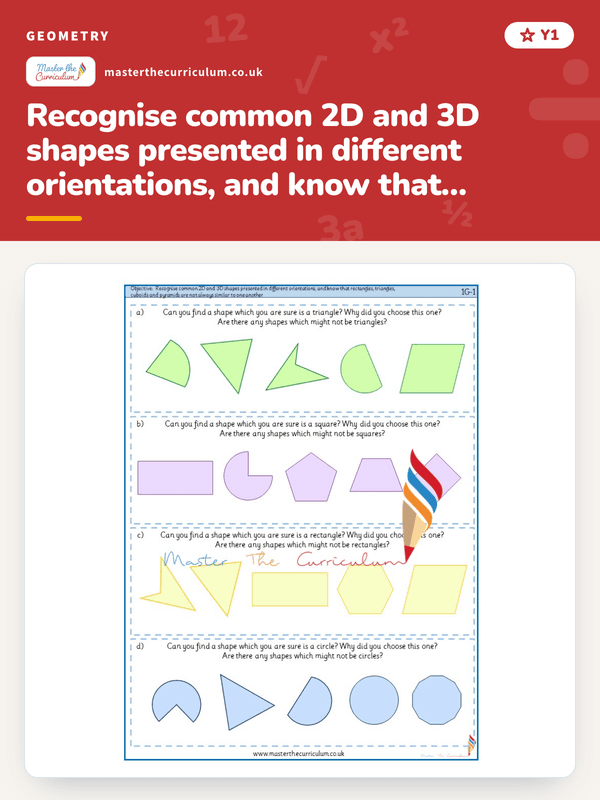
Recognise common 2D and 3D shapes presented in different orientations, and know that rectangles, triangles, cuboids and pyramids are not always similar to one another (2)

Recognise common 2D and 3D shapes presented in different orientations, and know that rectangles, triangles, cuboids and pyramids are not always similar to one another (3)

Use precise language to describe the properties of 2D and 3D shapes, and compare shapes by reasoning about similarities and differences in properties (1)

Use precise language to describe the properties of 2D and 3D shapes, and compare shapes by reasoning about similarities and differences in properties (2)

Use precise language to describe the properties of 2D and 3D shapes, and compare shapes by reasoning about similarities and differences in properties (3)

Use precise language to describe the properties of 2D and 3D shapes, and compare shapes by reasoning about similarities and differences in properties (4)

Showing 1 to 10 of 10 results
