Skip to content

Early YearsWorking Without Worksheets

L25 – WWW – Continue Repeated Patterns

Reception Working Without Worksheets lesson on continuing repeating patterns. Includes planning, movement starter, visual modelling, and hands-on cube, peg, bead, and outdoor activities.

CoverCover and first page

Preview only. The download is 4 files, listed in full below.

Every page is shown before you download. The files themselves come with membership, or sign in if you already have one.

Included with membership

Unlock with membership

Already a member? Sign in and it downloads from this page.

Keep it for later and group it with the rest of the block. No account needed to start.

  • Print it as it is, or as many as you need
  • Instant download, no watermark

About this resource

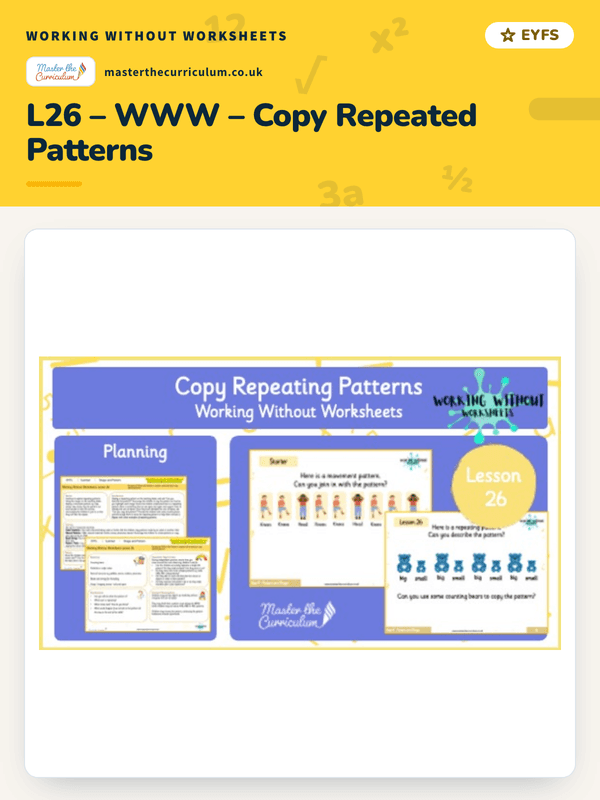
Working Without Worksheets – Reception Maths: Continuing Repeating Patterns Support your Reception pupils in developing early algebra skills with this Working Without Worksheets lesson on continuing repeating patterns. Through actions, cubes, natural objects, and beads, children learn to identify the unit of repeat in a pattern and extend it accurately. The lesson begins with a starter activity: Display a movement pattern on the slides (e.g. clap, clap, stamp). Say the pattern aloud and join in with the actions, encouraging the children to join in too. Ask: “What comes next?” to help children hear and feel the repeat. In the main input, children extend their understanding with visual patterns: Display a repeating pattern (e.g. images of animals, shapes, or colours). Ask: “Can you describe the pattern?” Highlight each image, encouraging children to say the pattern out loud. Support them to identify the unit of repeat and ask: “What comes next?” Confirm the next three images before moving on to other examples. For the independent activities, children continue patterns in hands-on, practical ways: Cube Trails – provide pattern starters using linking cubes. Children continue with AB, AAB, or ABB examples depending on ability. Natural Pattern Path – use stones, leaves, and twigs outdoors. Children extend natural object patterns to make paths or lines. Peg Board Patterns – begin simple colour patterns on peg boards (e.g. yellow, red, yellow, red) and children continue the line. Pattern Necklaces – start threading pasta or beads in a sequence, then children extend the necklace using the same pattern. Adults support by asking: “What is your pattern doing? What comes next?” The plenary brings the class back together: Share examples of extended patterns. Reinforce the concept of the unit of repeat and how this makes a pattern predictable. What’s Included in the Pack? ✔ Full teacher planning with objectives, vocabulary, and plenary questions ✔ Starter: movement pattern (clRead more

Working Without Worksheets – Reception Maths: Continuing Repeating Patterns Support your Reception pupils in developing early algebra skills with this Working Without Worksheets lesson on continuing repeating patterns. Through actions, cubes, natural objects, and beads, children learn to identify the unit of repeat in a pattern and extend it accurately. The lesson begins with a starter activity: Display a movement pattern on the slides (e.g. clap, clap, stamp). Say the pattern aloud and join in with the actions, encouraging the children to join in too. Ask: “What comes next?” to help children hear and feel the repeat. In the main input, children extend their understanding with visual patterns: Display a repeating pattern (e.g. images of animals, shapes, or colours). Ask: “Can you describe the pattern?” Highlight each image, encouraging children to say the pattern out loud. Support them to identify the unit of repeat and ask: “What comes next?” Confirm the next three images before moving on to other examples. For the independent activities, children continue patterns in hands-on, practical ways: Cube Trails – provide pattern starters using linking cubes. Children continue with AB, AAB, or ABB examples depending on ability. Natural Pattern Path – use stones, leaves, and twigs outdoors. Children extend natural object patterns to make paths or lines. Peg Board Patterns – begin simple colour patterns on peg boards (e.g. yellow, red, yellow, red) and children continue the line. Pattern Necklaces – start threading pasta or beads in a sequence, then children extend the necklace using the same pattern. Adults support by asking: “What is your pattern doing? What comes next?” The plenary brings the class back together: Share examples of extended patterns. Reinforce the concept of the unit of repeat and how this makes a pattern predictable. What’s Included in the Pack? ✔ Full teacher planning with objectives, vocabulary, and plenary questions ✔ Starter: movement pattern (cl

What you get, 4 files

  • PDFPlanning
  • PDFTeaching slides
  • PDFWorksheets
  • ZIPThe whole pack

This pack is listed as editable, so the editable copy comes with it. We do not print page counts here, because our catalogue does not publish them and a guessed number is worse than none.

The rest of this block

Working Without Worksheets, Early Years25 numbered lessons
  1. Lesson 18– WWW – Composition of 9 & 10
  2. Lesson 19– WWW – Number Bonds to 10
  3. Lesson 25 · you are here– WWW – Continue Repeated Patterns
  4. Lesson 26– WWW – Copy Repeated Patterns
  5. Lesson 27– WWW – Create Repeated Patterns

More working without worksheets for Early Years

Got a question about this resource?

Leave a message and we’ll get back to you.

Editable resourcesOpens in PowerPoint so you can edit to suit your classWhite Rose supportingFollows the small steps you already plan fromKey eventsSeasonal and cultural resources for the moments in the school yearReasoning Maths HubReasoning and problem solving, by year group

Sign up to keep updated on new resources

An email when there is something new for the year group you actually teach. Unsubscribe in a click.

Year group you teach

We keep your address, and the year group you teach, so we can tell you when there is something new for it. Here is how we look after it: privacy policy.