Skip to content

Early YearsGeometry

L23 – WWW – Compose Shapes

Reception Working Without Worksheets lesson on composing shapes. Includes planning, shape outline starter, modelling with triangles, and hands-on construction and puzzle activities.

CoverCover and first page

Preview only. The download is 4 files, listed in full below.

Every page is shown before you download. The files themselves come with membership, or sign in if you already have one.

Included with membership

Unlock with membership

Already a member? Sign in and it downloads from this page.

Keep it for later and group it with the rest of the block. No account needed to start.

  • Print it as it is, or as many as you need
  • Instant download, no watermark

About this resource

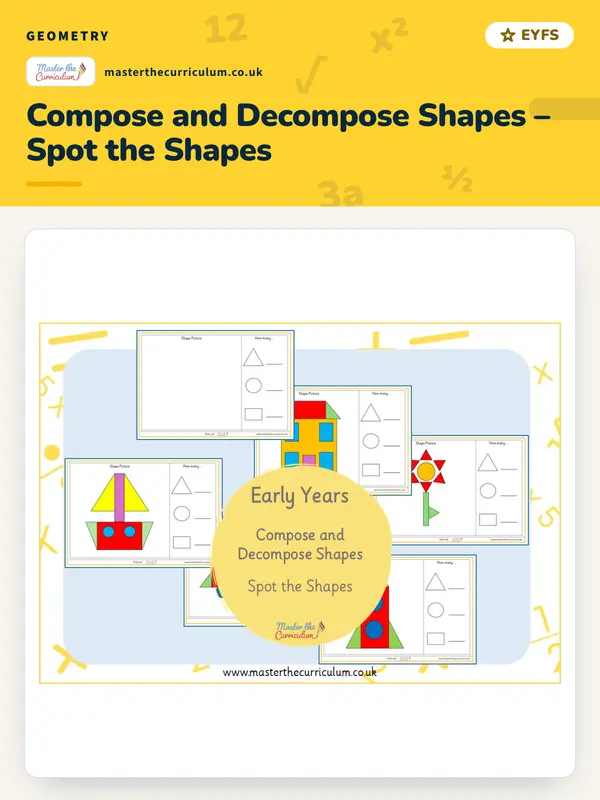
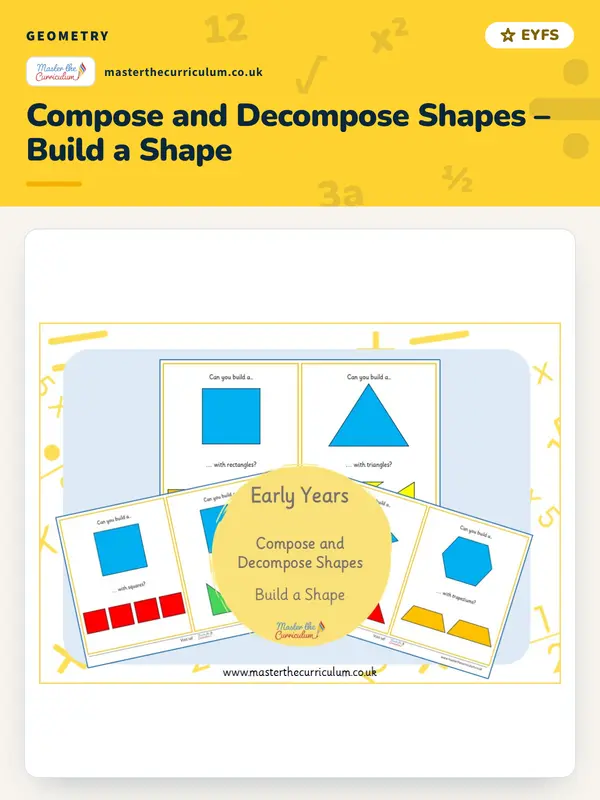
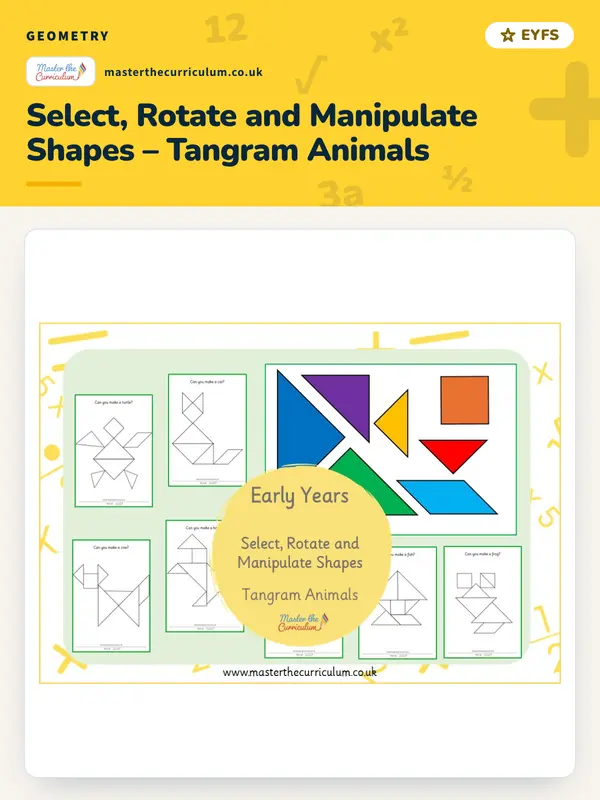
Working Without Worksheets – Reception Maths: Compose Shapes Introduce Reception pupils to the idea that larger shapes can be composed of smaller shapes with this Working Without Worksheets lesson. Children use squares, rectangles, triangles, and other 2-D shapes to explore how shapes fit together, rotate, and combine to create new ones. The lesson begins with a starter activity: Show an outline of a large square and provide smaller shapes. Model filling the outline with different combinations: e.g. a rectangle, a small square, and 2 triangles. Encourage discussion: “Which shapes fit? How can we combine them?” In the main input, children extend their understanding with new examples: Display another square outline alongside shapes: 2 triangles and a pentagon. Ask: “Which of these shapes could we use to fill the square?” Give children time to discuss and then model the solution using 2 triangles. Explore how triangles themselves can be composed in different ways—using a parallelogram, trapezium, or smaller triangles. Remind children they can rotate and flip shapes to make them fit. For the independent activity, children explore composition at two learning stations: Shape Construction Station – use small squares, rectangles, and triangles to create larger shapes (e.g. How many triangles make a square? ). Shape Matching & Puzzles – fill outline mats with larger shapes, rotating or flipping smaller ones as needed. The plenary brings the class together to discuss strategies: Share how children composed larger shapes and the combinations they discovered. Reinforce that shapes can combine in different ways, but still form the same whole. What’s Included in the Pack? ✔ Full teacher planning with objectives, modelling, and plenary questions ✔ Starter: fill a square outline using smaller shapes ✔ Teacher modelling: use 2 triangles to make a square, explore triangles with trapezium and parallelogram ✔ Vocabulary focus: compose, combine, rotate, flip, triangle, square, rectanRead more

Working Without Worksheets – Reception Maths: Compose Shapes Introduce Reception pupils to the idea that larger shapes can be composed of smaller shapes with this Working Without Worksheets lesson. Children use squares, rectangles, triangles, and other 2-D shapes to explore how shapes fit together, rotate, and combine to create new ones. The lesson begins with a starter activity: Show an outline of a large square and provide smaller shapes. Model filling the outline with different combinations: e.g. a rectangle, a small square, and 2 triangles. Encourage discussion: “Which shapes fit? How can we combine them?” In the main input, children extend their understanding with new examples: Display another square outline alongside shapes: 2 triangles and a pentagon. Ask: “Which of these shapes could we use to fill the square?” Give children time to discuss and then model the solution using 2 triangles. Explore how triangles themselves can be composed in different ways—using a parallelogram, trapezium, or smaller triangles. Remind children they can rotate and flip shapes to make them fit. For the independent activity, children explore composition at two learning stations: Shape Construction Station – use small squares, rectangles, and triangles to create larger shapes (e.g. How many triangles make a square? ). Shape Matching & Puzzles – fill outline mats with larger shapes, rotating or flipping smaller ones as needed. The plenary brings the class together to discuss strategies: Share how children composed larger shapes and the combinations they discovered. Reinforce that shapes can combine in different ways, but still form the same whole. What’s Included in the Pack? ✔ Full teacher planning with objectives, modelling, and plenary questions ✔ Starter: fill a square outline using smaller shapes ✔ Teacher modelling: use 2 triangles to make a square, explore triangles with trapezium and parallelogram ✔ Vocabulary focus: compose, combine, rotate, flip, triangle, square, rectan

What you get, 4 files

  • PDFPlanning
  • PDFTeaching slides
  • PDFWorksheets
  • ZIPThe whole pack

This pack is listed as editable, so the editable copy comes with it. We do not print page counts here, because our catalogue does not publish them and a guessed number is worse than none.

The rest of this block

Geometry, Early Years9 numbered lessons

  1. Lesson 20– WWW – Recognise 3D Shapes
  2. Lesson 21– WWW – Recognise 2-D Shapes
  3. Lesson 22– WWW – Rotate Shapes
  4. Lesson 23 · you are here– WWW – Compose Shapes
  5. Lesson 24– WWW – Decompose Shapes

More geometry for Early Years

Got a question about this resource?

Leave a message and we’ll get back to you.

Editable resourcesOpens in PowerPoint so you can edit to suit your classWhite Rose supportingFollows the small steps you already plan fromKey eventsSeasonal and cultural resources for the moments in the school yearReasoning Maths HubReasoning and problem solving, by year group

Sign up to keep updated on new resources

An email when there is something new for the year group you actually teach. Unsubscribe in a click.

Year group you teach

We keep your address, and the year group you teach, so we can tell you when there is something new for it. Here is how we look after it: privacy policy.