Compose and Decompose Shapes – Spot the Shapes
Included with membership
Trusted by primary teachers across the UK · New resources every week
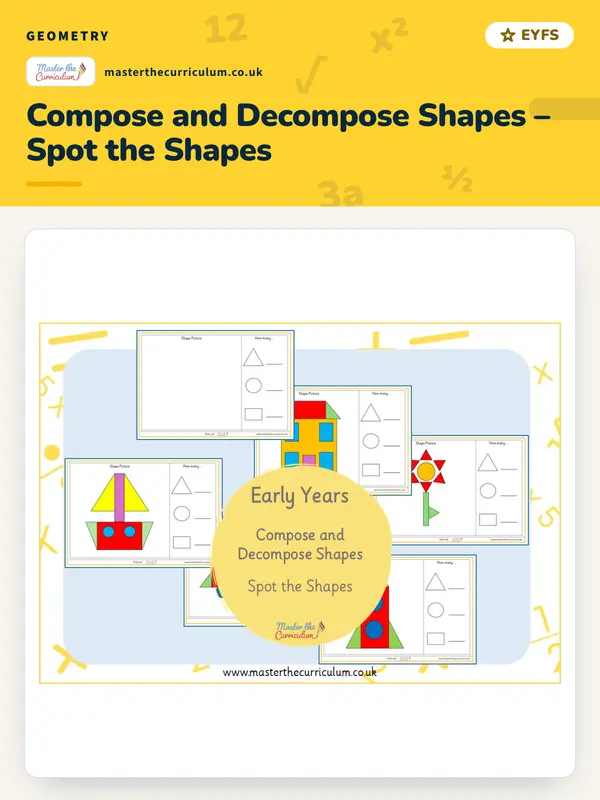
Reception Working Without Worksheets lesson on decomposing shapes. Includes planning, tangram exploration, and playdough decomposition activity.
Preview only. The download is 4 files, listed in full below.
Every page is shown before you download. The files themselves come with membership, or sign in if you already have one.
Included with membership
Unlock with membershipAlready a member? Sign in and it downloads from this page.
Keep it for later and group it with the rest of the block. No account needed to start.
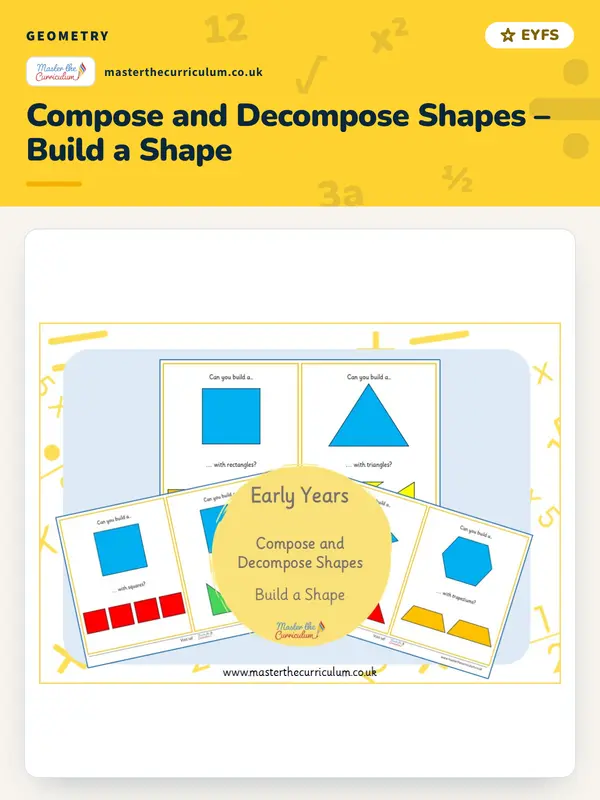
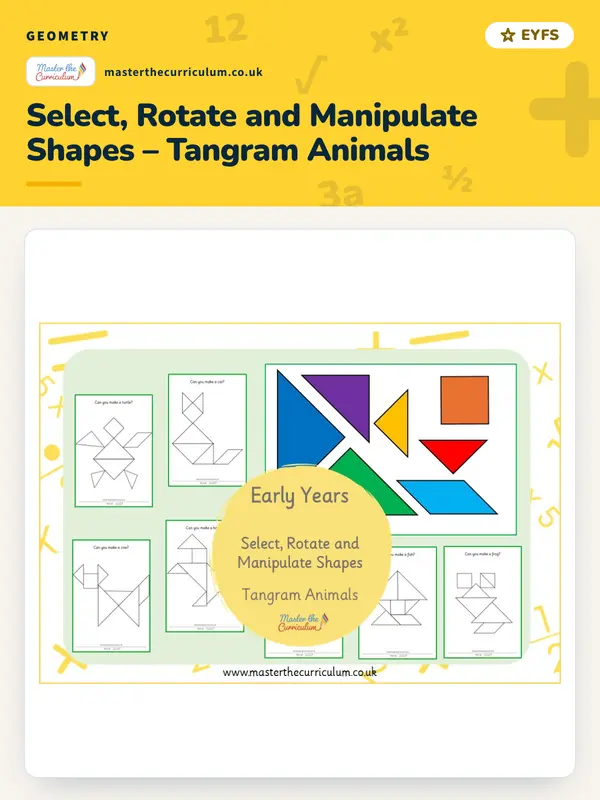
Working Without Worksheets – Reception Maths: Decomposing Shapes Help your Reception pupils build spatial reasoning with this Working Without Worksheets lesson on decomposing shapes. Building on the previous lesson about composing shapes, children now explore how larger shapes can be split into smaller ones. Using tangrams, playdough, and shape cutters, they learn that a single shape can be divided in different ways while keeping its properties. The lesson begins with a starter activity: Show a square and ask: “Can you see any smaller shapes inside the square?” Model cutting the square into 2 rectangles, then into 2 triangles. Emphasise that the square is still made up of shapes that have their own properties. In the main input, children explore tangrams: Show a square tangram and explain that the large square has been split into many smaller shapes. Ask: “What shapes can you see in the square?” Examine the shapes in turn. Point out that there are 5 triangles —all have 3 sides, but they appear in different orientations and sizes. Discuss how decomposing a shape helps us see both parts and wholes. For the independent activity, children explore decomposition hands-on: Playdough Decomposition – children cut out a square, rectangle, or triangle from playdough. They then use a tool to cut the shape into 2, 3, or 4 smaller shapes. Encourage them to describe what they made: “I cut a square into 2 triangles” or “I cut a rectangle into 3 smaller rectangles.” Discuss whether the new shapes are the same or different. The plenary consolidates learning: Bring the class together to look at examples of decomposed shapes. Reinforce that a whole shape can be split into parts in many ways. Link back to composing shapes: shapes can join together and also split apart. What’s Included in the Pack? ✔ Full teacher planning with objectives, vocabulary, and plenary questions ✔ Starter: explore smaller shapes inside a square by cutting it into parts ✔ Teacher modelling: use a tangram to
This pack is listed as editable, so the editable copy comes with it. We do not print page counts here, because our catalogue does not publish them and a guessed number is worse than none.
Geometry, Early Years9 numbered lessons