Skip to content

Early YearsWorking Without Worksheets

L28 – WWW – Compare Lengths

Reception Working Without Worksheets lesson on comparing length. Includes planning, teaching slides, practical activities, and plenary challenges.

CoverCover and first page

Preview only. The download is 4 files, listed in full below.

Every page is shown before you download. The files themselves come with membership, or sign in if you already have one.

Included with membership

Unlock with membership

Already a member? Sign in and it downloads from this page.

Keep it for later and group it with the rest of the block. No account needed to start.

  • Print it as it is, or as many as you need
  • Instant download, no watermark

About this resource

Working Without Worksheets – Reception Maths: Compare Length This Working Without Worksheets Reception maths lesson introduces children to the concept of comparing length. Through practical activities, real-life examples, and hands-on exploration, children begin to use key mathematical language such as longer, shorter, and the same length. The starter activity makes learning engaging and relatable: Ask children to look at their own hands and compare their fingers. Discuss which finger is the longest and which is the shortest. Introduce the key vocabulary in context so children can use it to describe everyday objects. In the main input, children explore comparing lengths using familiar objects: Compare two pieces of ribbon, identifying which is longer and which is shorter. Move on to pencils of different lengths, demonstrating how to line them up carefully to compare. Discuss examples where the objects are the same length, reinforcing the importance of accurate comparisons. Use questioning such as: “Which pencil is the longest? Which is the shortest? How do you know?” The independent activity encourages hands-on exploration: Children select two objects from around the classroom. They line them up carefully and decide which is longer and which is shorter. This develops early reasoning skills and gives opportunities to apply new vocabulary in practical contexts. The plenary reinforces learning: Challenge children to find something in the classroom that is longer than a crayon and shorter than a ruler. Discuss their choices as a class, focusing on accurate use of the terms longer, shorter, and the same length. What’s Included in the Pack? ✔ Full lesson plan with objectives, teaching notes, and plenary questions ✔ Animated teaching slides introducing key vocabulary and examples ✔ Starter activity: comparing fingers by length ✔ Main teaching with ribbons and pencils to model comparisons ✔ Independent task: comparing classroom objects ✔ Plenary: practical challenRead more

Working Without Worksheets – Reception Maths: Compare Length This Working Without Worksheets Reception maths lesson introduces children to the concept of comparing length. Through practical activities, real-life examples, and hands-on exploration, children begin to use key mathematical language such as longer, shorter, and the same length. The starter activity makes learning engaging and relatable: Ask children to look at their own hands and compare their fingers. Discuss which finger is the longest and which is the shortest. Introduce the key vocabulary in context so children can use it to describe everyday objects. In the main input, children explore comparing lengths using familiar objects: Compare two pieces of ribbon, identifying which is longer and which is shorter. Move on to pencils of different lengths, demonstrating how to line them up carefully to compare. Discuss examples where the objects are the same length, reinforcing the importance of accurate comparisons. Use questioning such as: “Which pencil is the longest? Which is the shortest? How do you know?” The independent activity encourages hands-on exploration: Children select two objects from around the classroom. They line them up carefully and decide which is longer and which is shorter. This develops early reasoning skills and gives opportunities to apply new vocabulary in practical contexts. The plenary reinforces learning: Challenge children to find something in the classroom that is longer than a crayon and shorter than a ruler. Discuss their choices as a class, focusing on accurate use of the terms longer, shorter, and the same length. What’s Included in the Pack? ✔ Full lesson plan with objectives, teaching notes, and plenary questions ✔ Animated teaching slides introducing key vocabulary and examples ✔ Starter activity: comparing fingers by length ✔ Main teaching with ribbons and pencils to model comparisons ✔ Independent task: comparing classroom objects ✔ Plenary: practical challen

What you get, 4 files

  • PDFPlanning
  • PDFTeaching slides
  • PDFWorksheets
  • ZIPThe whole pack

This pack is listed as editable, so the editable copy comes with it. We do not print page counts here, because our catalogue does not publish them and a guessed number is worse than none.

The rest of this block

Working Without Worksheets, Early Years25 numbered lessons
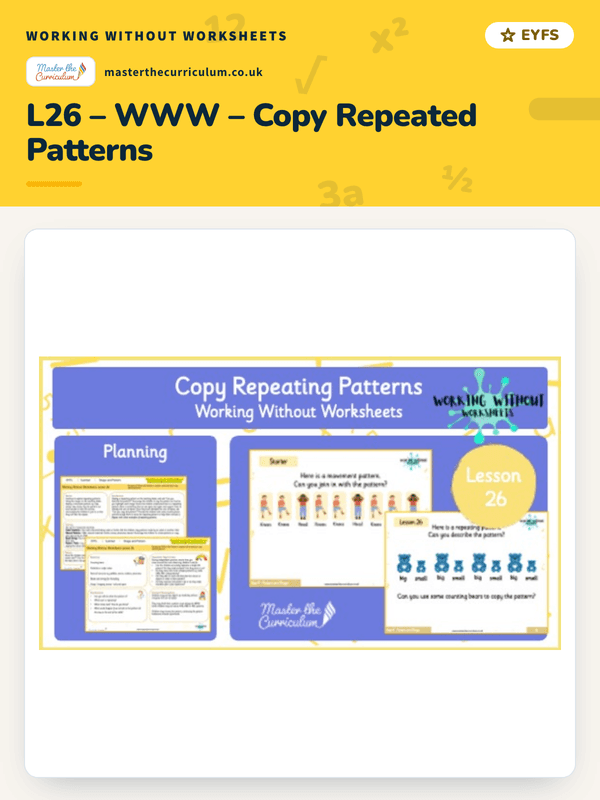
  1. Lesson 26– WWW – Copy Repeated Patterns
  2. Lesson 27– WWW – Create Repeated Patterns
  3. Lesson 28 · you are here– WWW – Compare Lengths
  4. Lesson 29– WWW – Compare Weight
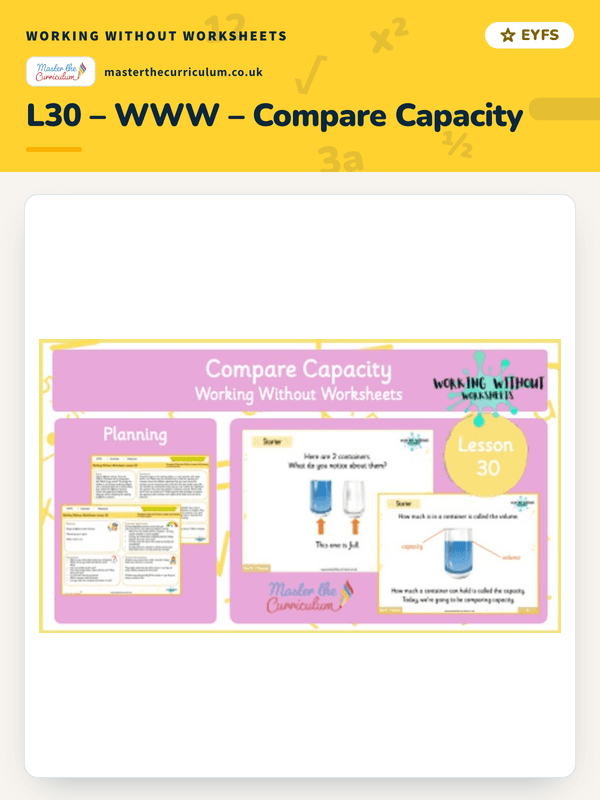
  5. Lesson 30– WWW – Compare Capacity

More working without worksheets for Early Years

Got a question about this resource?

Leave a message and we’ll get back to you.

Editable resourcesOpens in PowerPoint so you can edit to suit your classWhite Rose supportingFollows the small steps you already plan fromKey eventsSeasonal and cultural resources for the moments in the school yearReasoning Maths HubReasoning and problem solving, by year group

Sign up to keep updated on new resources

An email when there is something new for the year group you actually teach. Unsubscribe in a click.

Year group you teach

We keep your address, and the year group you teach, so we can tell you when there is something new for it. Here is how we look after it: privacy policy.