Skip to content

Year 4Working Without Worksheets

L3 Convert Between Kilograms and Grams

Teach Year 4 pupils to convert between kilograms and grams with this engaging, worksheet-free maths lesson. Featuring interactive teaching slides, practical activities and reasoning challenges, this resource helps children master metric mass conversions in line with the National Curriculum.

CoverCover and first page

Preview only. The download is 4 files, listed in full below.

Every page is shown before you download. The files themselves come with membership, or sign in if you already have one.

Included with membership

Unlock with membership

Already a member? Sign in and it downloads from this page.

Keep it for later and group it with the rest of the block. No account needed to start.

  • Print it as it is, or as many as you need
  • Instant download, no watermark

About this resource

Build your Year 4 pupils' confidence in converting between kilograms and grams with this engaging, worksheet-free maths lesson designed for the Spring Measurement unit. This comprehensive resource helps children understand the relationship between kilograms (kg) and grams (g), using the key fact that 1 kilogram = 1,000 grams. Through clear teacher modelling, interactive teaching slides and practical activities, pupils learn how to convert confidently between the two units by multiplying and dividing by 1,000 before applying their understanding in reasoning and problem-solving tasks. The lesson begins by revisiting units of mass before introducing kilogram and gram conversions using visual models, worked examples and class discussion. Pupils then reinforce their learning through practical, hands-on activities, partner work and comparison tasks that encourage mathematical reasoning and deepen conceptual understanding. Designed as a worksheet-free lesson, this resource promotes active learning while providing teachers with assessment opportunities, key questions and guidance on addressing common misconceptions. This resource includes: Complete Year 4 lesson planning Interactive teaching slides with animations Practical worksheet-free learning activities Kilograms and grams conversion tasks Fluency, reasoning and problem-solving opportunities Whole-class discussion and partner activities Key assessment questions Common misconceptions and teaching guidance Curriculum Coverage: Year 4 Measurement Convert between kilograms and grams Multiply and divide by 1,000 Compare and order masses Develop fluency and mathematical reasoning Apply metric unit conversions in real-life contexts Perfect for teachers looking for an engaging alternative to traditional worksheets, this lesson supports pupils in developing a secure understanding of metric mass while encouraging discussion, reasoning and confident application of their learning. National Curriculum Objective: Convert between difRead more

Build your Year 4 pupils' confidence in converting between kilograms and grams with this engaging, worksheet-free maths lesson designed for the Spring Measurement unit. This comprehensive resource helps children understand the relationship between kilograms (kg) and grams (g), using the key fact that 1 kilogram = 1,000 grams. Through clear teacher modelling, interactive teaching slides and practical activities, pupils learn how to convert confidently between the two units by multiplying and dividing by 1,000 before applying their understanding in reasoning and problem-solving tasks. The lesson begins by revisiting units of mass before introducing kilogram and gram conversions using visual models, worked examples and class discussion. Pupils then reinforce their learning through practical, hands-on activities, partner work and comparison tasks that encourage mathematical reasoning and deepen conceptual understanding. Designed as a worksheet-free lesson, this resource promotes active learning while providing teachers with assessment opportunities, key questions and guidance on addressing common misconceptions. This resource includes: Complete Year 4 lesson planning Interactive teaching slides with animations Practical worksheet-free learning activities Kilograms and grams conversion tasks Fluency, reasoning and problem-solving opportunities Whole-class discussion and partner activities Key assessment questions Common misconceptions and teaching guidance Curriculum Coverage: Year 4 Measurement Convert between kilograms and grams Multiply and divide by 1,000 Compare and order masses Develop fluency and mathematical reasoning Apply metric unit conversions in real-life contexts Perfect for teachers looking for an engaging alternative to traditional worksheets, this lesson supports pupils in developing a secure understanding of metric mass while encouraging discussion, reasoning and confident application of their learning. National Curriculum Objective: Convert between dif

What you get, 4 files

  • PDFPlanning
  • PDFTeaching slides
  • PDFWorksheets
  • ZIPThe whole pack

This pack is listed as editable, so the editable copy comes with it. We do not print page counts here, because our catalogue does not publish them and a guessed number is worse than none.

The rest of this block

Working Without Worksheets, Year 411 numbered lessons

  1. Lesson 1Convert Between Kilometres and Metres
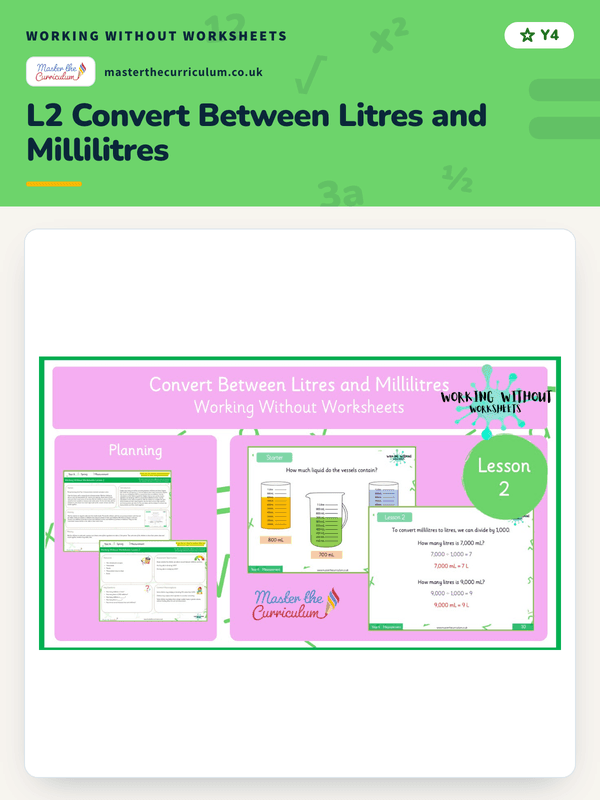
  2. Lesson 2Convert Between Litres and Millilitres
  3. Lesson 3 · you are hereConvert Between Kilograms and Grams
  4. Lesson 4Count in Multiples of 25
  5. Lesson 5Count in Multiples of 1,000

More working without worksheets for Year 4

Got a question about this resource?

Leave a message and we’ll get back to you.

Editable resourcesOpens in PowerPoint so you can edit to suit your classWhite Rose supportingFollows the small steps you already plan fromKey eventsSeasonal and cultural resources for the moments in the school yearReasoning Maths HubReasoning and problem solving, by year group

Sign up to keep updated on new resources

An email when there is something new for the year group you actually teach. Unsubscribe in a click.

Year group you teach

We keep your address, and the year group you teach, so we can tell you when there is something new for it. Here is how we look after it: privacy policy.