Compose and Decompose Shapes – Spot the Shapes
Included with membership
Trusted by primary teachers across the UK · New resources every week
Develop children’s spatial reasoning with this practical 2D shapes activity. Children select, rotate and manipulate shapes to copy pictures while developing shape recognition, visualisation and problem-solving skills.
Preview only. The download is one file, listed in full below.
Every page is shown before you download. The files themselves come with membership, or sign in if you already have one.
Included with membership
Unlock with membershipAlready a member? Sign in and it downloads from this page.
Keep it for later and group it with the rest of the block. No account needed to start.
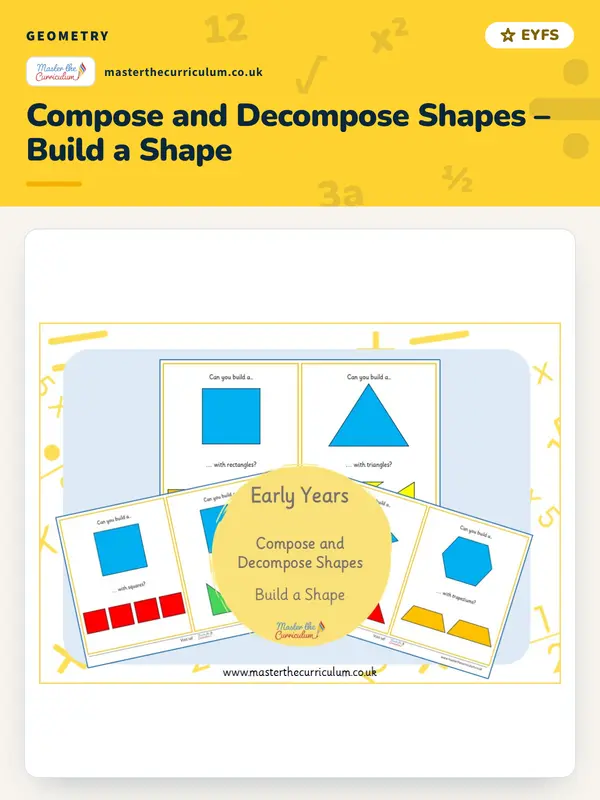
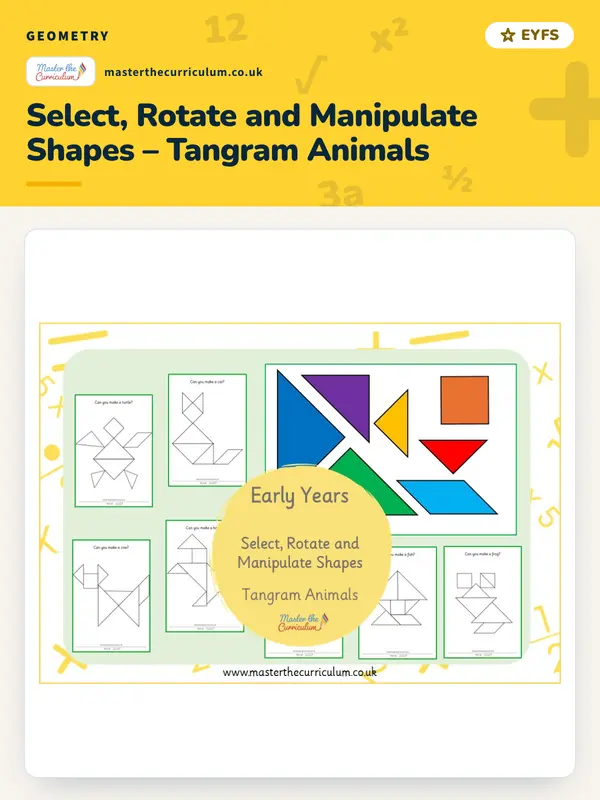
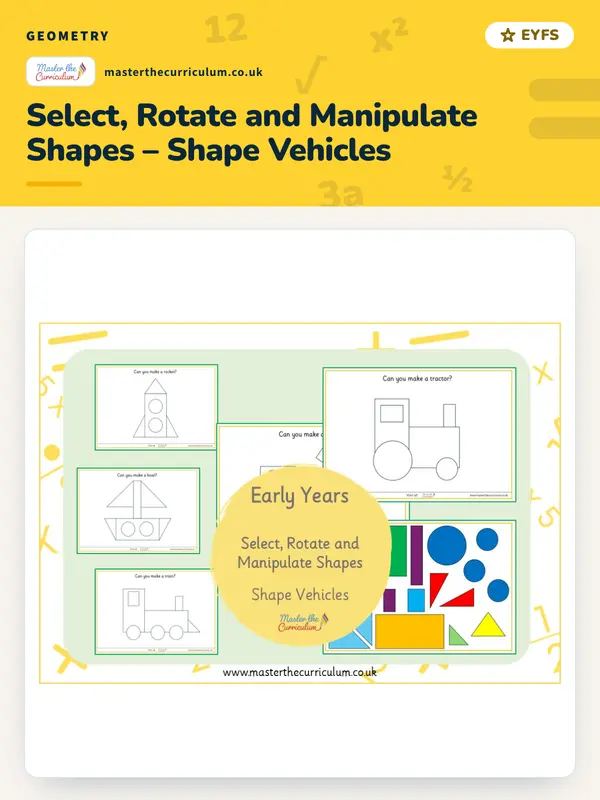
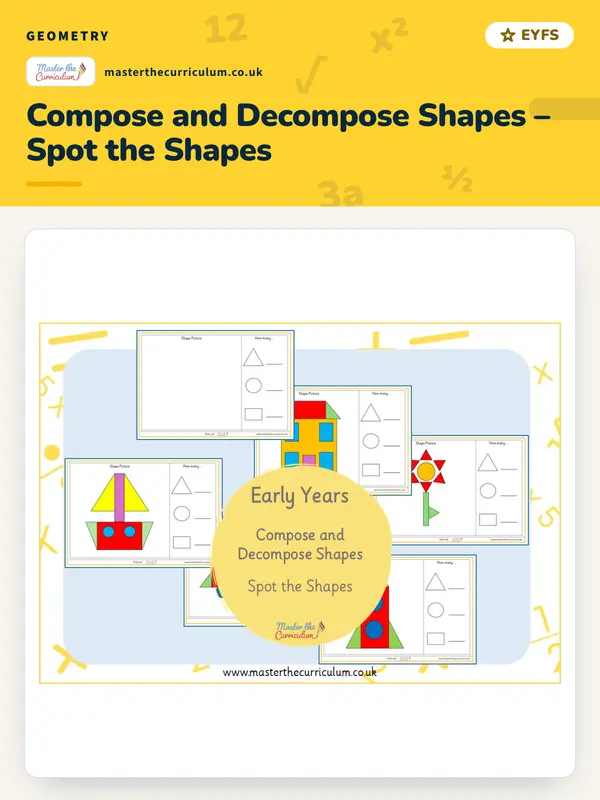
Help children develop their spatial reasoning skills with this practical 2D shapes maths activity. Children use a range of 2D shapes to copy pictures, developing their ability to select, rotate and manipulate shapes to recreate a visual model. To prepare the activity, laminate the template cards so they can be used repeatedly. Provide children with a selection of 2D shapes and ask them to choose the shapes they need to copy one of the pictures. Children will need to look carefully at the picture and think about which shapes they need, where they should be positioned and how they may need to be rotated. This encourages children to develop their visualisation, spatial awareness and problem-solving skills through hands-on mathematical exploration. The activity is ideal for Early Years and KS1, providing opportunities to recognise and compare common 2D shapes while developing an understanding of their position and orientation. Children can practise: Developing spatial reasoning skills Recognising and naming 2D shapes Selecting appropriate shapes Rotating and manipulating shapes Comparing shapes Understanding position and orientation Developing visualisation skills Problem-solving Using mathematical language The activity provides lots of opportunities for mathematical discussion. Encourage children to explain their choices and describe the shapes they have used. Useful questions include: “What shapes have you used?” “How many ___ have you used?” “How are these shapes the same?” “How are they different?” “What happens when you rotate this shape?” “Which way does this shape need to face?” The laminated template cards make this resource ideal for a maths area or continuous provision, where children can revisit the pictures and experiment with different combinations of shapes. It can also be used as a teacher-led focus group to model spatial language and develop children’s reasoning. For differentiation, provide a smaller selection of shapes for children who need additional
This pack is print and go. Our catalogue does not list an editable copy of it, so none is offered here rather than promising a file nobody has opened. Page counts are not printed either, because we do not publish them and a guessed number is worse than none.
Our own system, with the star count repeated in every worksheet header so a child can be handed the right sheet without a word.