What are the Ready to Progress criteria?
The NCETM, the National Centre for Excellence in the Teaching of Mathematics, identified the key objectives children should meet by the end of each year. The criteria are the parts of the curriculum flagged as priority: get these secure and a child is ready for the next year group.
There are 384 resources filed against them across the whole primary range, 46 of them here.
Arriving from Year 1?
The Year 1 criteria are what a child should have secure before they start Year 2. There are 45 resources for checking.
Year 1 Ready to Progress →Number and Place Value
13 resources
Multiplication and Division
8 resources
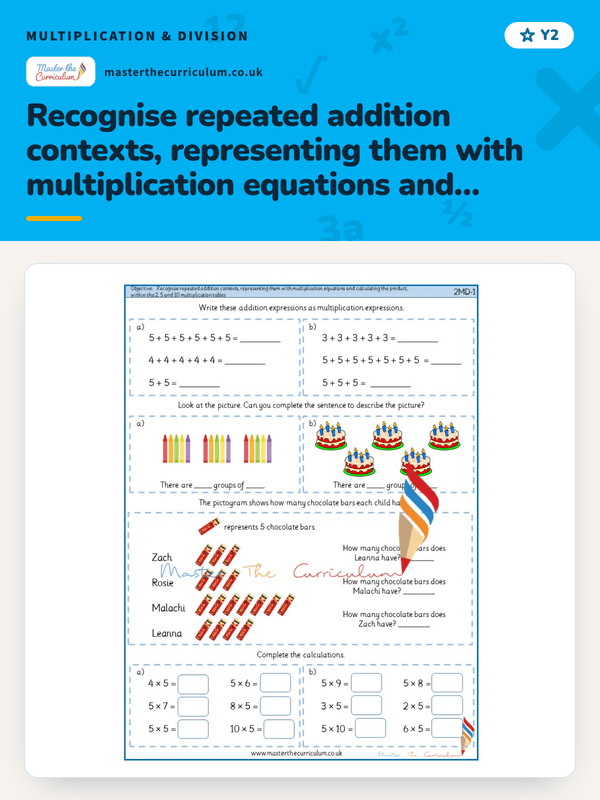
Recognise repeated addition contexts, representing them with multiplication equations and calculating the product, within the 2, 5 and 10 multiplication tables (6)

Recognise repeated addition contexts, representing them with multiplication equations and calculating the product, within the 2, 5 and 10 multiplication tables (5)
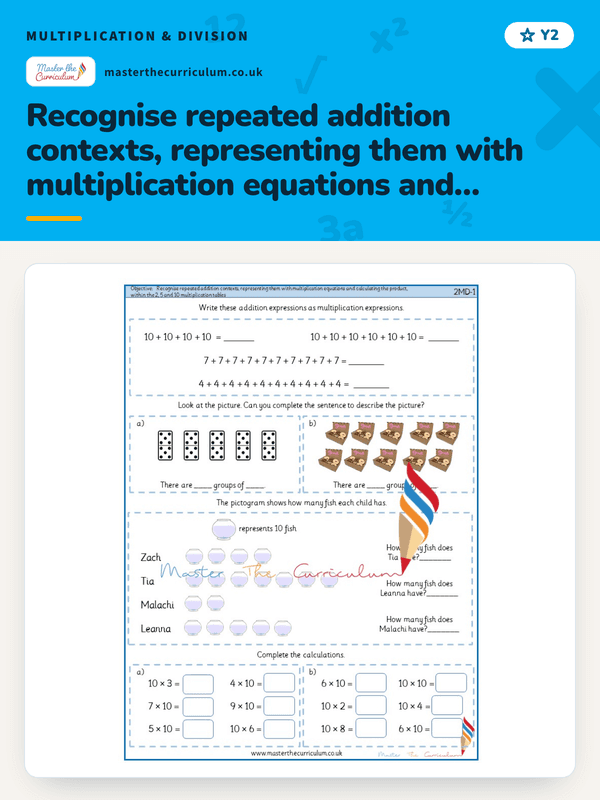
Recognise repeated addition contexts, representing them with multiplication equations and calculating the product, within the 2, 5 and 10 multiplication tables (4)
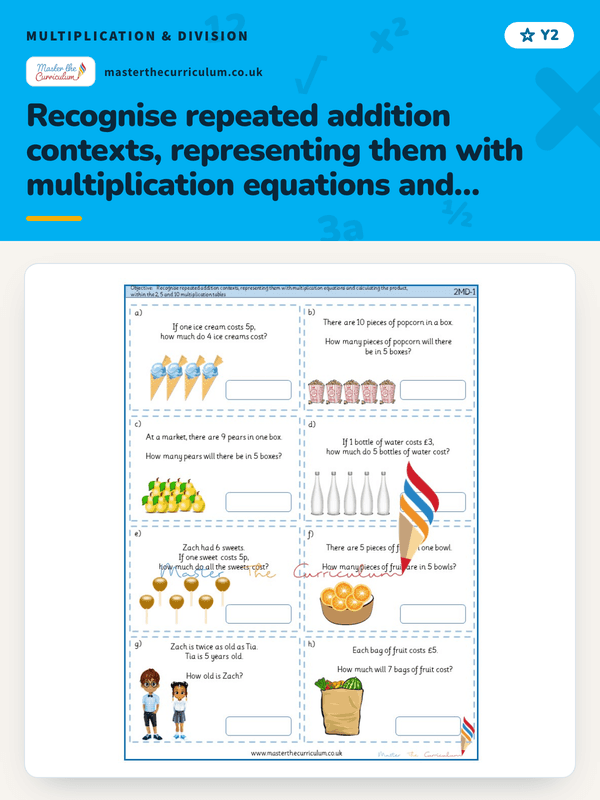
Recognise repeated addition contexts, representing them with multiplication equations and calculating the product, within the 2, 5 and 10 multiplication tables (3)
Relate grouping problems where the number of groups is unknown to multiplication equations with a missing factor, and to division equations (quotative division) – 1

Relate grouping problems where the number of groups is unknown to multiplication equations with a missing factor, and to division equations (quotative division) – 2

Recognise repeated addition contexts, representing them with multiplication equations and calculating the product, within the 2, 5 and 10 multiplication tables (2)

Recognise repeated addition contexts, representing them with multiplication equations and calculating the product, within the 2, 5 and 10 multiplication tables (1)

Use precise language to describe the properties of 2D and 3D shapes, and compare shapes by reasoning about similarities and differences in properties (2)

Use precise language to describe the properties of 2D and 3D shapes, and compare shapes by reasoning about similarities and differences in properties (3)

Use precise language to describe the properties of 2D and 3D shapes, and compare shapes by reasoning about similarities and differences in properties (4)

Use precise language to describe the properties of 2D and 3D shapes, and compare shapes by reasoning about similarities and differences in properties (1)

Next in the sequence: Year 3 Ready to Progress (76)